
Georgia is one of the friendliest states in the Southeast for building a barndominium. Land is still affordable across much of the state, the statewide building code is clear and consistently enforced, and rural counties give you room to build a shop-house or acreage home without the red tape you’d hit closer to Atlanta. The catch is that Georgia treats a barndominium as a residential dwelling — there’s no shortcut through an agricultural exemption — so you build it to the same code as any other house. That’s a good thing: it protects your investment and keeps it appraisable and insurable.
This guide covers what you need to know before you build in Georgia — the current building codes, wind and climate requirements, septic and permitting, realistic 2026 costs, vetted Georgia builders, and how to finance the project.
Does Georgia have a statewide building code?

Yes. Georgia adopts statewide minimum construction codes through the Department of Community Affairs (DCA), and every county and city enforces them. As of 2026 the mandatory codes include the 2024 International Residential Code (IRC) with Georgia Amendments, along with the 2024 editions of the building, plumbing, mechanical, and fuel-gas codes and the 2023 National Electrical Code. Your barndominium is built and inspected as a single-family dwelling under the IRC.
The one place Georgia lags is energy. The mandatory energy code is still the 2015 International Energy Conservation Code (IECC) with Georgia supplements — roughly a decade behind the current model cycle. That matters for a metal building in Georgia’s humid climate: the code minimum is the floor, not the target. Budget for a well-detailed vapor barrier and insulation above the minimum — closed-cell spray foam or SIP panels — or you’ll fight condensation and high cooling bills for the life of the home.
Because the code is statewide, the rules don’t change much from county to county — but the permitting office, fees, and turnaround do. Metro-Atlanta counties and incorporated cities run stricter zoning and plan review; rural, unincorporated counties are faster and more flexible, and a number of Georgia’s rural counties have limited or no countywide zoning at all. Always confirm requirements with the county building and zoning office for your specific parcel before you buy.
No agricultural exemption in Georgia
This is the single most common misunderstanding, so it’s worth being direct: you cannot build a live-in barndominium in Georgia under a “farm building” or agricultural exemption. Georgia’s farm-building exemption under O.C.G.A. § 8-2-25 is narrow — it covers things like NRCS-designed manure storage and composting facilities and explicitly excludes residential use.
In practice that means your barndominium is permitted, inspected, and taxed as a residential dwelling, the same as a stick-built home. You’ll pull a residential building permit, meet the IRC, and pass the same inspections. Don’t let a kit salesperson or an out-of-state forum convince you there’s an ag loophole — building “as a barn” and later moving in is how people end up unable to get a certificate of occupancy, a mortgage, or homeowner’s insurance.
Wind design by region
Georgia spans three broad wind zones, and your kit and engineering have to match the county you’re building in:
| Region | Design wind speed (approx.) |
|---|---|
| North & Middle Georgia | 110–115 mph |
| Augusta / CSRA corridor & South Georgia | 115–120 mph |
| Coastal Georgia (Chatham, Glynn, Camden, etc.) | up to 140 mph |
If you’re on or near the coast, the higher design speeds — and coastal exposure — drive heavier framing, closer fastener spacing, and stronger anchorage. This is exactly where a properly engineered steel or SIP shell earns its keep. Make sure any kit you price is engineered and stamped for your county’s wind speed, not a generic national spec — an underrated kit is the most expensive mistake you can make here.
Septic, wells, and soil evaluations
Most rural Georgia barndominiums are on a private well and septic system, and this is where a lot of budgets get surprised. Georgia runs uniform statewide onsite-sewage rules through the Georgia Department of Public Health (DPH), but your local County Board of Health issues the actual septic permit and inspects the system.
The critical step is the soil evaluation (percolation/soil test) before you buy the land. A soil scientist or the county environmental health office evaluates the soil’s ability to absorb effluent, which determines whether the parcel will perc, what kind of system you need, and how many bedrooms you can permit — septic sizing in Georgia is tied to bedroom count, which directly limits how big a home you can build. A standard soil evaluation typically runs a few hundred dollars and a week or two to schedule.
Budget realistically by result. A conventional gravity septic system on good soil commonly runs $5,000–$12,000. If the soil drains poorly or the water table is high — common in parts of South Georgia and the coastal plain — you may need an engineered or alternative system (pump, drip, or aerobic treatment), which can run $15,000–$30,000+. Never close on rural land without a soil evaluation contingency; a failed perc can quietly erase your whole plan.
Georgia climate and moisture
Georgia’s heat, humidity, and termite pressure shape how you should build. Steel framing removes the primary termite food source but doesn’t eliminate the risk to interior wood, trim, and finishes, so keep standard soil treatment and termite bonds in the plan. The bigger day-to-day issue is moisture: in a humid climate, a metal building lives and dies by its vapor barrier and insulation detailing. Closed-cell spray foam or SIPs, a proper vapor retarder, and a right-sized HVAC system with good dehumidification are what separate a comfortable Georgia barndominium from a sweaty, condensation-prone one. Insulate above the 2015 IECC minimum — you’ll earn it back in comfort and power bills.
Questions for DCA’s Construction Codes Program: (404) 679-3118 or [email protected].
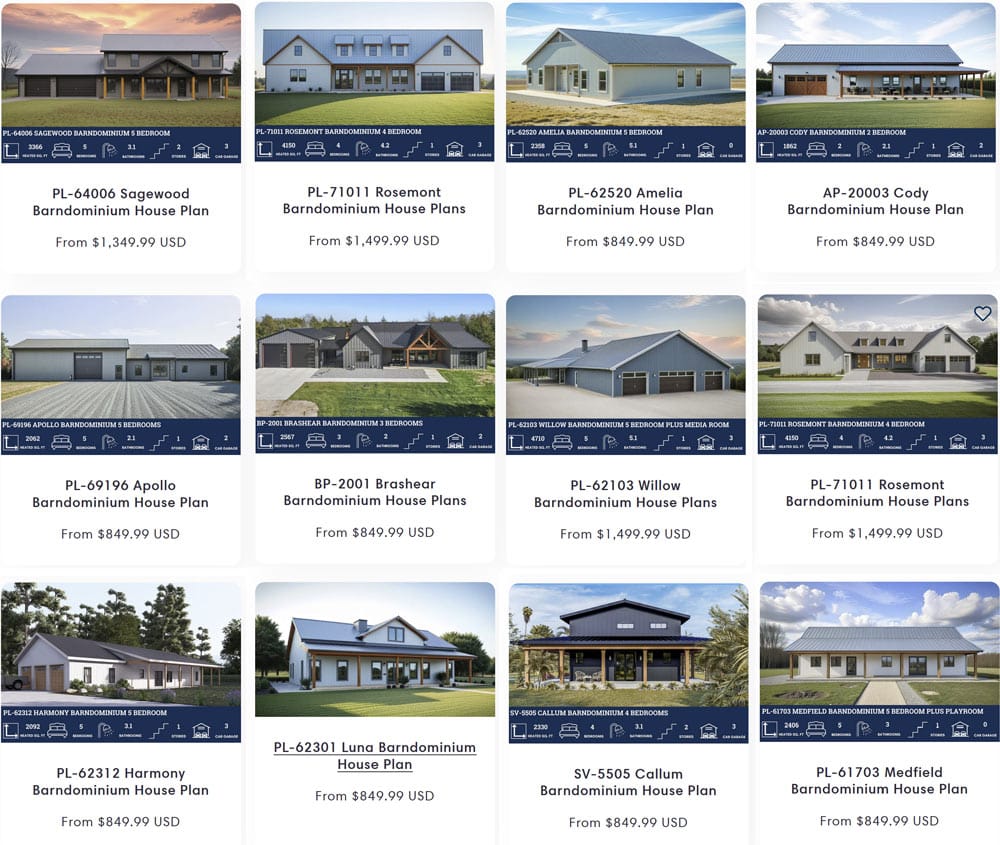
Georgia Barndominium Plans Best Sellers
How much does a barndominium cost to build in Georgia?
Georgia sits near the national average, and often a little below it thanks to affordable land and a deep bench of metal-building suppliers. All of the figures below come from our barndominium cost guide, which has the full breakdown and a calculator:
| Build stage | Cost per sq ft | What it includes |
|---|---|---|
| Kit materials only | $20 – $35 | Steel or SIP shell package, delivered |
| Shell, erected | $30 – $50 | Kit up, dried-in, on your slab |
| Finished — standard | $65 – $120 | Move-in ready, mid-grade finishes |
| Finished — high-end | $130 – $200 | Premium finishes, custom details |
For a popular 40×60 (2,400 sq ft) build at a standard finish, that’s roughly $156,000–$288,000 turnkey in Georgia, with most owner-directed projects landing in the middle of that range. A kit covers the shell only — budget the slab, interior, and site work separately.
One warning specific to shopping kits: avoid packages priced below about $20 per square foot. Those are usually agricultural-grade barn kits not engineered for residential occupancy, the wrong wind rating, or insulation and code detailing you’ll pay to fix later. Price the shell as part of a finished home, not as a standalone barn.
Beyond the shell and finishes, budget for land, site prep and a slab, the well and septic, utility hookups, and a driveway/culvert — the line items that most often blow a rural Georgia budget. The cost guide breaks each one down.
Recommended Georgia barndominium builders

Looking for a barndominium builder in Georgia? These are Georgia-based companies we’ve dealt with or vetted.
BN Buildings
770-A County Line-Auburn Rd
Winder, GA 30680
(470) 410-2050
BN Buildings are our top choice for affordable, super-durable, and highly customizable top-quality steel buildings. They have solutions for any Barndo, Garage, Storage or Shop, Commercial, Industrial, Retail, Training or Agricultural Facility, Quonset Hut, Carport, etc.
They are now our preferred vendor for all pre-engineered metal buildings in the US. We are able to offer our customers the best prices with nationwide delivery.
Let Ben know you heard about BN Buildings from Ian with Barndominium.org for exclusive discounts on all barndo kits.
Arco Steel
3300 Holcomb Bridge Rd
Peachtree Corners, GA 30092
800-241-8339
Arco Steel was first established back in 1979. With years of experience in local building regulations, their knowledge within the industry is second to none. They have manufacturers located at multiple points across North America to reduce freight charges, save money and speed-up delivery timelines.
They can build any size kit to meet your barndo requirements. We have spoken to the owners about their barndominium kit offerings and they are among the nicest and most personable people in the steel buildings industry. If you are building in Georgia, you should start with Arco. They are the best barndominium builder from start to finish we have dealt with recently.
SteelCo
55 Oxford Business Pkwy, Suite A
Oxford, GA 30054
866-986-5362
https://www.steelcobuildings.com/
SteelCo offers a wide range of steel building products and designs, including barndominium floor plans. Their high-quality barndo designs range from 2,376 square feet to 3,928 square feet. Buyers are free to customize their plans and create the home of their dreams.
Their plans include fully dimensional floor plans, building sections, roof plans, exterior elevations, electrical plans, and schedules and details. Buyers can use these plans to start getting bids from contractors to build their new homes.
Prospective buyers can get a free quote from the company’s website.
Georgia Metals
539 General Daniel Ave. North,
Danielsville, GA 30633
706-795-3144
https://www.georgiametals.com/
Georgia Metals offers fully customizable barndominiums at competitive pricing. All of their structures feature Valspar protection against weather and UV damage.
The company is family-owned and operated, and they stand by their products. They offer free quotes through their website.
Along with barn homes, Georgia Metals also offers steel buildings, metal roofing, pole barns, agricultural products, gutters and more.
Barndominiums Of Georgia
8990 Highway 5
Douglasville, GA 30134
678-387-6610
If you’re looking for a barndominium for sale in Georgia, Barndominiums of Georgia is a great place to start.
The company has standard floor plans that you can customize to match your vision.
The company can assist with the design, planning and construction of your new barndominium living space. They also offer steel kits that are packed and ready for shipping.
How to vet a Georgia builder

Given how much wind design, permitting and climate demands shift across the state, a builder with recent experience in your region matters more here than in geographically uniform states. Ask:
- Have you built in this specific region recently? North Georgia mountain experience doesn’t transfer automatically to coastal wind engineering
- What wind design speed are your kits engineered for at my address?
- How do you handle termite and moisture protection specifically — not as a general selling point?
- Can I see references or photos from completed local projects?
How to vet a Georgia builder: confirm they’re licensed and insured for residential work, ask for two or three barndominium references in your county, and make sure they’ll build to your county’s wind zone and pull the residential permits (not “as a barn”). A builder who understands the local Board of Health septic process and the DCA code is worth more than the cheapest bid.
Are you a Georgia barndominium builder who’d like to be listed here? Get in touch.
Start with a floor plan
Most Georgia projects start with a plan, then get matched to a local builder or kit. You can browse hundreds of ready-to-build barndominium designs — filtered by size and bedroom count — and customize any of them to your lot:
Browse barndominium floor plans →
Popular starting points: the 40×60 (2,400 sq ft) — the most-built size in Georgia — the more compact 40×40, or the roomy 50×60. You can also shop by bedroom count, from 3-bedroom family plans to 4-bedroom layouts with a shop.
Financing a barndominium in Georgia
Financing is very doable in Georgia, but the appraisal is where barndominiums get tripped up, so line up the right lender early. USDA Rural Development loans — often with $0 down — cover most of rural Georgia and are one of the best tools for a country build. Construction-to-permanent loans are the standard route for a build; VA loans and Farm Credit lenders are worth checking for veterans and larger rural parcels.
Two Georgia-specific tips: use a lender who has actually financed barndominiums before (builder-affiliated and local lenders usually move faster than national banks), and insist on an appraiser with barndominium experience — a generic appraisal that treats your home as a “metal building” can come in low enough to sink the loan.
Our full barndominium financing guide walks through loan types, the appraisal issue, and how to prepare. (General information, not financial advice.)
Georgia barndominium FAQ
Are barndominiums legal in Georgia?
Yes. There’s no state prohibition on barn-style or metal homes. The structure must meet the Georgia State Minimum Standard Codes — as of January 2026, the 2024 IRC with Georgia Amendments — and you’ll need local zoning approval plus a building permit.
Can I build a barndominium under a farm/agricultural exemption in Georgia?
No. Georgia’s farm-building exemption (O.C.G.A. § 8-2-25) is narrow and excludes residential use. A live-in barndominium must be permitted as a house — building it “as a barn” and moving in later risks losing your certificate of occupancy, mortgage, and insurance.
What wind speed does my barndominium need to be engineered for?
It depends where in Georgia you’re building — roughly 110–115 mph in the mountains and Middle Georgia, 115–120 mph across the CSRA and South Georgia, and up to 140 mph on the coast. Confirm the figure with your county building department and check any kit quote against it.
How much does a barndominium cost in Georgia?
Most finish out at $65–$120 per square foot turnkey (standard finish), or roughly $156,000–$288,000 for a 40×60. A shell kit alone is $20–$35 per square foot in materials. See the cost guide for a full breakdown.
Do I need a septic soil test before buying land in Georgia?
Effectively, yes — always make a soil evaluation a contingency of any rural land purchase. The soil test determines whether the parcel will perc, what system you need, and how many bedrooms you can permit. A failed perc can require a $15,000–$30,000+ engineered system or make the lot unbuildable.
Which parts of Georgia are easiest to build in?
Rural counties in the agricultural heartland generally offer the most straightforward permitting. Metro Atlanta adds complexity and HOA restrictions; coastal counties add hurricane wind design and stricter plan review. The Piedmont counties just outside the metro core are often the sweet spot — accessible permitting with reasonable land prices.
Do barndominiums hold up to Georgia termites?
Better than conventional wood framing, since steel removes the primary food source. But soil treatment requirements still apply, and termites can damage interior framing, sheathing and insulation regardless of frame material. It’s a significant advantage, not immunity.
What’s the difference between a barndominium and a pole barn in Georgia?
A pole barn (post-frame) is an agricultural or storage structure; a barndominium is a residence — whether it’s steel-frame or post-frame — permitted and finished to residential code. The framing method matters less than the fact that a barndominium is built as a code-compliant home.
Can I live in my barndominium while I finish it?
Only after it passes inspection and receives a certificate of occupancy for the finished portion. Many Georgia owners phase the build — finishing the living quarters first — but you can’t legally occupy it until the county signs off. Talk to your county building office about phased inspections before you start.
Ready to start your Georgia build?
Start with a floor plan — over 1,200 stock plans, any of which can be modified. Browse barndominium floor plans →
Work out your budget — see our full cost guide →
Compare your options — Get started →
Whichever route you take in Georgia: confirm your county’s zoning before you buy, get your design wind speed in writing, arrange a soil evaluation for septic, and permit the build as a residence.
This page is for general informational purposes and isn’t a substitute for confirming requirements directly with your county building and zoning office, your county Board of Health, a licensed Georgia contractor, or a mortgage professional. Codes and local ordinances change — verify current requirements for your specific parcel before you build.
If you would like to add your business to our state guides or run a feature profile on our site please contact us below. Please send your featured build images, project details and company history to us.
If you would like to add your business to our state guides or run a feature profile on our site, contact us below. Please send your featured build images, project details and company history to us.
This page is for general informational purposes and isn't a substitute for confirming requirements directly with your county's building and zoning office, a licensed state contractor, or a mortgage professional.
We Offer 3 Paths To Get Started
Choose Your Floor plan
Choose from over 1,200 ready-to-build stock plans, available for instant download. Most stock plans can be modified to fit your specific lot starting at $400.
Best for: Residential Homes – Ready To Build
CREATE Your CUSTOM DESIGN
Have your plan drawn to fit your lot and your exact layout — no compromises. $2 per square foot for heated/living areas and $0.50 for unheated spaces.
Best for: Residential Homes – Complete Design Control
Start With A Kit
Steel kits are best for DIY customers, commercial buildings, workshops, or those looking for max savings. They are delivered to you, and you or your contractors erect the kit.
Best for: DIY Customers, Shop Houses & Garages