
New York is a more complicated place to build a barndominium than most states, and the complexity comes from two directions that rarely get mentioned together.
The state runs a single Uniform Code that applies everywhere outside New York City — which is genuinely helpful, because the technical requirements don’t change at the county line. But layered on top of that are some of the strongest local zoning powers in the country, a six-million-acre park where a state agency reviews development before you can so much as clear a building site, and a septic regime where 47 of 62 counties impose stricter rules than the state baseline.
None of that makes a barndominium impossible here. Plenty get built every year, particularly across the Finger Lakes, the Southern Tier and Western New York. It does mean the sequence matters, and that the questions you ask before buying land are different from the ones you’d ask in Missouri.
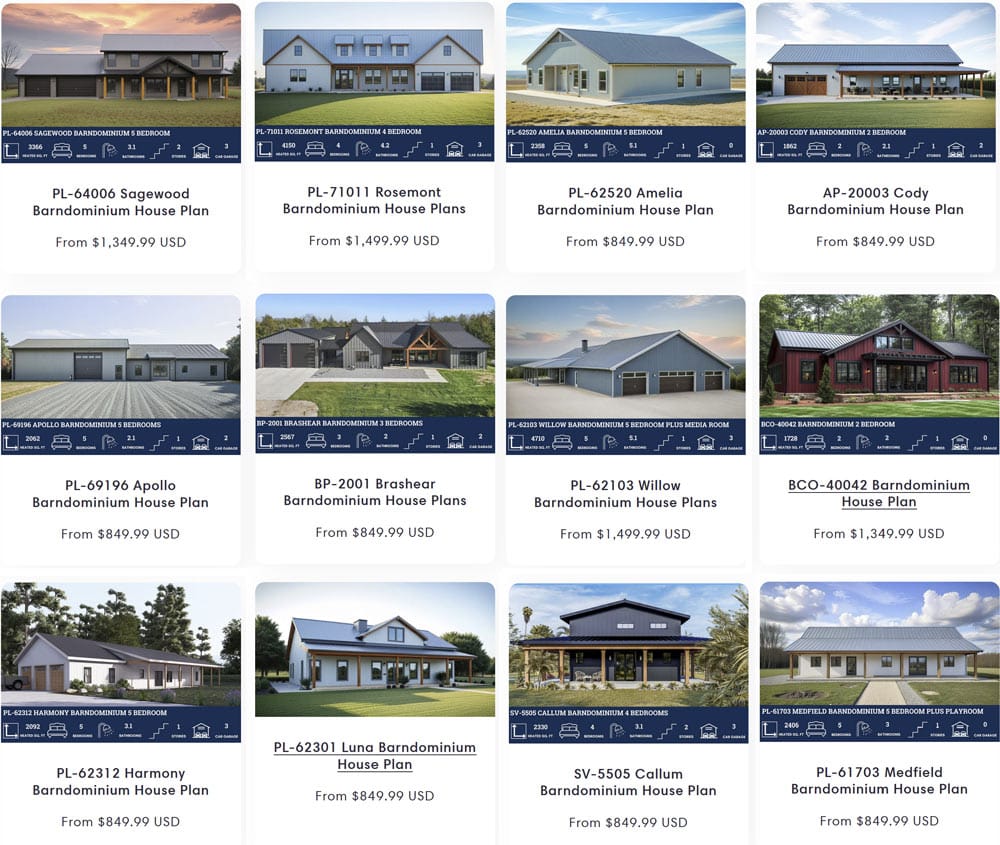
New York Barndominium Plans Best Sellers
The New York State Uniform Code
Construction in New York is governed by the Uniform Fire Prevention and Building Code and the Energy Conservation Construction Code, both contained in Title 19 of the New York Codes, Rules and Regulations (19 NYCRR). They incorporate the International Code Council’s model codes by reference, with New York amendments, and are administered by the Department of State’s Division of Building Standards and Codes.
Two practical points:
The Uniform Code applies statewide outside New York City. NYC operates its own construction code, which is a different world and not one where barndominiums are realistic. Everywhere else — which is the whole of upstate, the Hudson Valley, Long Island and the Finger Lakes — you’re building to the Uniform Code.
The Energy Code is demanding. New York has pursued aggressive energy standards, and this matters disproportionately for a metal or post-frame building. A steel shell has poor inherent thermal performance and thermal bridging through steel framing is a real problem in a state with long, cold winters. Batt insulation between framing won’t get you there. Most New York barndominium builds land on closed-cell spray foam or structural insulated panels. See our insulation guide for the tradeoffs.
Enforcement is local. Your town, village or city code enforcement officer issues the building permit and performs inspections.
What it costs to build in New York
New York has one of the widest internal cost ranges of any state. A build in the Southern Tier or the western counties is a fundamentally different financial project from one in Westchester or on Long Island, and any single statewide figure hides more than it reveals.
Nationally, finished barndominiums run roughly $65 to $160 per square foot, with shell-only kits at $20 to $50. New York runs above the national average, and for identifiable reasons: snow-rated trusses, deep frost footings, Energy Code insulation requirements, and labour rates that are high by national standards — dramatically so downstate.
The things that move your number most here are the region you build in, your finish level, and whether the site needs a well, septic and long utility runs.
For the full breakdown — cost by size, the line-item budget, shell versus finished, and an interactive calculator you can run for your own square footage — see our barndominium cost guide.
Note: an earlier version of this page cited $270 per square foot for barndominiums and $330 for conventional homes in New York. Those figures reflected downstate custom construction rather than the state as a whole, and have been removed.
Recommended barndominium builders in New york State

Before you call anyone, know which model you want — turnkey (they design, build and finish), shell or erected (you hire trades for the interior), or kit (materials shipped, erection and finishing are yours to arrange). Getting that wrong is the most common source of budget shock.
Are You A Barndominium Builder in New York? Feature Your Best Build Here
We work with a small number of barndominium builders in each region — not a directory, and not one company per state. If you build barndominiums in New York and want your projects in front of homeowners who are actively planning one, we would like to see your work.
Send us two to three completed builds, the regions you serve, and your license details. We review every submission and reply either way.
Financing a barndominium in New York
Most conventional mortgage lenders won’t finance a barndominium through standard Fannie Mae or Freddie Mac programmes. The reliable routes are regional banks, credit unions and Farm Credit associations with local property knowledge.
Two New York institutions that offer construction lending and are worth a conversation:
- Wallkill Valley Federal Savings and Loan — operating since 1913, with branches across the Hudson Valley, offering construction loans
- Walden Savings Bank — Montgomery-based, in business since 1872, offering FHA, USDA and construction loans
Most buyers use a construction-to-permanent loan, which funds the build in draws and converts to a mortgage at completion. A practical tip: describe the project as a custom home with the construction method specified rather than leading with “barndominium,” since the term still means nothing to some underwriting departments.
Our financing guide covers the process in more detail.
Local zoning — where most of the real variation lives
New York towns hold unusually strong land use authority. The Uniform Code is consistent statewide, but zoning is entirely local, and it’s where barndominiums most often run into trouble.
Before you buy, call the town’s building or zoning office about the specific parcel and ask:
- What zoning district applies, and is a single-family dwelling permitted?
- Is a post-frame or metal-clad residence permitted, or are there exterior material standards?
- Is there a minimum dwelling size?
- What are the setbacks, and is there a maximum lot coverage?
- Does the town require site plan review or a special use permit for this?
- Is the parcel in an agricultural district, and does that change anything?
Some towns are entirely comfortable with barn-style homes; others have appearance standards that make a metal exterior difficult. That’s a five-minute phone call that can save a land purchase.
The Adirondack Park Agency — the six-million-acre question
If your land sits inside the Adirondack Park, this section matters more than anything else on the page, and almost no barndominium guide mentions it.
The Adirondack Park covers roughly six million acres of northern New York — larger than several states — and about half of it is privately owned. Development on that private land is regulated by the Adirondack Park Agency under the APA Act and its implementing regulations at 9 NYCRR §§ 570–588, in addition to whatever your town requires.
What makes this different from ordinary permitting:
Where an APA permit is required, you cannot undertake the activity in any way until the permit is issued — and the Agency defines that broadly. It includes:
- Road construction
- Grading and excavation
- Landscaping
- Clearing of building sites
- Installation of utilities
- Conveyance of any subdivision lot
In other words, you can’t start clearing while the paperwork is in progress. The APA runs an enforcement programme, and the restriction has teeth.
A small percentage of projects go to public hearing, typically larger ones or where the Agency believes the project may not be approvable. Notably, the Agency cannot deny an application without first holding an adjudicatory hearing — which is a protection for applicants, but it also means contested projects take considerably longer.
Additional state laws overlay the same area: the Freshwater Wetlands Act (Environmental Conservation Law Article 24) and the Wild, Scenic and Recreational Rivers System Act (Article 15, Title 27).
Practical advice: if you’re looking at land in Clinton, Essex, Franklin, Fulton, Hamilton, Herkimer, Lewis, Oneida, Saratoga, St. Lawrence, Warren or Washington counties, check whether the parcel falls inside the Blue Line before you make an offer, and call the APA about the specific property. It’s a free call, and APA jurisdiction is not something to discover after closing.
The Catskill Park operates under different rules but is worth checking for similar reasons if you’re buying in Greene, Ulster, Sullivan or Delaware counties.
Septic — Appendix 75-A, and the 47-county problem
Most rural New York barndominiums need an onsite wastewater system, and New York’s approach to this is genuinely two-tiered.
The state baseline is Appendix 75-A of the State Sanitary Code, which sets minimum design standards for onsite wastewater treatment systems. The Department of Health administers it, working alongside the Department of Environmental Conservation.
But counties can — and mostly do — go further. State law allows counties to exceed the 75-A minimums, and 47 of 62 counties impose stricter requirements. County health departments cannot adopt standards less stringent than the state baseline without a waiver from the Commissioner of Health.
What that looks like in practice:
- Westchester County requires professional engineer involvement for all new system designs, not just large-capacity ones
- Nassau County drops the engineer threshold to 500 gallons per day, which captures most residential installations
- Suffolk County requires PE certification for systems over 1,000 gallons per day
- Rural counties like Hamilton and Essex stick closer to the state baseline
- Transfer inspections — requiring inspection when a property is sold — are mandatory in only 12 counties
The process: submit a permit application to your county health department with system design plans, soil test results and a site survey, at least 30 days before construction. Permit fees range from around $75 in rural counties to $650 in Suffolk, with most charging $150–$300 for a residential system.
Get a percolation test before you close on land. A parcel that won’t support a conventional system isn’t unbuildable, but engineered alternatives cost enough to change your budget materially — and in a state where the rules shift at the county line, what’s acceptable is genuinely unpredictable until you ask.
Note that where APA jurisdiction applies, the Agency may impose its own septic conditions on top of the county’s.
Snow load, frost depth and building for New York winters
New York carries some of the heaviest design snow loads in the country, and they vary enormously across the state. The Tug Hill Plateau east of Lake Ontario receives among the highest snowfall totals in the eastern United States; the Adirondacks and the Southern Tier are also demanding. Long Island and the lower Hudson Valley are a different climate entirely.
Two things follow:
Your truss package must be engineered to your specific location’s ground snow load. For a clear-span barndominium — one large uninterrupted roof with no interior bearing walls — this is the single biggest structural cost driver in the state. Ask any supplier which snow load their package is designed for, and whether they asked where you’re building before quoting. If they didn’t ask, the quote isn’t for your building.
Frost depth is deep across most of New York, and post-frame column footings must extend below the frost line or freeze-thaw cycling will heave the building over successive winters. Your code enforcement officer will give you the required depth for your location — get it in writing before you excavate, because a shallow footing fails inspection after you’ve paid to dig it.
Frequently Asked Questions
Are barndominiums legal in New York? Yes. There’s no state prohibition on barn-style or metal homes. The structure must meet the New York State Uniform Code and Energy Code, and you’ll need local zoning approval plus a building permit from your town. Some towns have exterior material standards or minimum dwelling sizes that affect what you can build, so check the specific parcel.
What if my land is in the Adirondack Park? You may need a permit from the Adirondack Park Agency in addition to your town permit. Where APA jurisdiction applies you cannot begin any work — including clearing the building site, grading or installing utilities — until the permit is issued. Check whether the parcel is inside the Blue Line before making an offer, and call the APA about the property.
Do I need a septic permit? Yes, for any new onsite system. Apply to your county health department at least 30 days before construction with design plans, soil test results and a site survey. Fees run roughly $75–$650 depending on county. Note that 47 of 62 New York counties impose stricter standards than the state Appendix 75-A baseline, so requirements vary considerably.
How much does a barndominium cost in New York? New York runs above the national range of $65–$160 per square foot finished, driven by snow-rated trusses, deep frost footings, Energy Code insulation and labour rates. The internal range across the state is enormous — a Southern Tier build and a Westchester build are different projects. See our full cost guide for the breakdown and a calculator.
What snow load does my barndominium need? It depends on your specific location, and New York’s range is wide — the Tug Hill Plateau and Adirondacks are among the most demanding in the eastern US. Get the design ground snow load for your address from your code enforcement officer before accepting any truss quote.
Which parts of New York are easiest to build in? Generally the Finger Lakes, Southern Tier and Western New York — more affordable land, towns familiar with post-frame construction, and an established builder base. The Adirondack Park adds APA review; downstate adds cost and stricter local zoning.
Where do I find barndominium floor plans? Start with our barndominium floor plans — over 1,200 stock plans that can be modified, plus custom design services.
Ready to start your New York build?
Start with a floor plan — over 1,200 stock plans, any of which can be modified. Browse barndominium floor plans →
Start with a prefab shell — SIP shell kits, which suit New York’s Energy Code requirements particularly well. See prefab shells →
Start with a steel kit — best for DIY builders, workshops and maximum savings. See your options →
Whichever route you take in New York: confirm town zoning before you buy, check whether the parcel falls inside the Adirondack Park, get a percolation test, and get your design snow load in writing.
This page is for general informational purposes and isn't a substitute for confirming requirements directly with your town or county building and zoning office, your county health department, the Adirondack Park Agency where applicable, a licensed New York contractor, or a mortgage professional. Codes and local ordinances change — verify current requirements for your specific parcel before you build.
If you would like to add your business to our state guides or run a feature profile on our site please contact us below. Please send your featured build images, project details and company history to us.
If you would like to add your business to our state guides or run a feature profile on our site, contact us below. Please send your featured build images, project details and company history to us.
This page is for general informational purposes and isn't a substitute for confirming requirements directly with your county's building and zoning office, a licensed state contractor, or a mortgage professional.
We Offer 3 Paths To Get Started
Choose Your Floor plan
Choose from over 1,200 ready-to-build stock plans, available for instant download. Most stock plans can be modified to fit your specific lot starting at $400.
Best for: Residential Homes – Ready To Build
CREATE Your CUSTOM DESIGN
Have your plan drawn to fit your lot and your exact layout — no compromises. $2 per square foot for heated/living areas and $0.50 for unheated spaces.
Best for: Residential Homes – Complete Design Control
Start With A Kit
Steel kits are best for DIY customers, commercial buildings, workshops, or those looking for max savings. They are delivered to you, and you or your contractors erect the kit.
Best for: DIY Customers, Shop Houses & Garages