
Alabama is one of the easiest and most affordable states in the country to build a barndominium. Land is cheap, winters are mild, and across most of rural Alabama there’s little or no building-code enforcement — in much of the state you can build with a remarkably free hand. The flip side is that Alabama’s freedom is a patchwork: whether anyone inspects your build depends entirely on your city and county, and the Gulf Coast plays by much stricter rules than the rest of the state.
This guide covers the two things that shape every Alabama project — the local-only code reality and the Gulf Coast wind requirements — plus septic and permitting, realistic 2026 costs, vetted Alabama builders, and how to finance the build.
Does Alabama have a statewide building code?
Technically yes, but in practice it’s decided locally. Alabama has adopted the 2015 International Residential Code (IRC) as its statewide residential standard, with residential code adoption now overseen by the Alabama Home Builders Licensure Board. The catch is enforcement: the code is enforced only by local governments that maintain building departments. Most Alabama counties do not actively enforce residential building codes in unincorporated areas, which creates a patchwork where the permitting experience varies dramatically from one parcel to the next.
What that means on the ground:
Inside a city or town with a building department, you’ll pull a building permit and be inspected to the 2015 IRC like anywhere else. In unincorporated rural county land — a big share of Alabama — there’s often no building permit or inspection at all. That freedom is real, but it cuts both ways: no inspector means no one is catching mistakes, and you still need the home built to real residential standards to insure, finance, or sell it later.
A few things apply almost everywhere regardless of building-code enforcement: electrical, plumbing, and HVAC work is governed by Alabama’s state professional licensing boards; septic permits come from your county health department; and floodplain permits are issued by the county for FEMA-designated flood zones. The single most important first step is to call your county (and city, if applicable) to confirm exactly what’s required for your specific parcel before you buy.
No agricultural exemption for a home
Because so much of Alabama is rural and lightly regulated, people assume they can put up “a barn” and live in it. Alabama does offer current-use valuation that lowers property tax on genuine agricultural land — but that’s a tax classification, not a building exemption. A structure you live in is a dwelling. Even in a county with no building inspection, treat it as a home: proper foundation, wiring to code, a permitted septic system, and insurable construction. Building “as agricultural” and moving in is how owners end up unable to finance or insure the place.
Tornadoes and inland wind
Most of Alabama sits in “Dixie Alley,” one of the most dangerous tornado regions in the country — and unlike the Plains, Alabama’s tornadoes often strike at night and move fast. Inland design wind speeds run about 115–120 mph, lighter than the coast, but the tornado risk is the reason to build tougher than the minimum. The best money you can spend on an Alabama barndominium is a safe room or storm shelter — an interior reinforced room or a below-slab shelter built to FEMA P-361 / ICC 500 standards. Many of our floor plans include a safe room, and it’s worth specifying one wherever you build in Alabama.
The Gulf Coast: Mobile and Baldwin counties
Coastal Alabama is a different world from the rest of the state. After Hurricane Katrina, the two coastal counties — Mobile and Baldwin — adopted much stricter wind codes, with design wind speeds up to roughly 140–150 mph near the water. If you’re building south of I-10, your kit and engineering have to be rated for it, and a properly engineered steel or SIP shell is essential, not optional.
The good news is that Alabama has built an unusually strong incentive system around coastal resilience. The IBHS FORTIFIED construction standard — a set of stronger roof, connection, and opening details — is widely used on the coast, and Alabama law requires insurers to give premium discounts for FORTIFIED homes, which on the coast can be substantial. On top of that, the Strengthen Alabama Homes (SAH) grant program offers eligible homeowners up to $10,000 toward a FORTIFIED roof. If you’re building or buying on the coast, designing to FORTIFIED from the start can pay for itself through lower insurance for the life of the home — ask your builder and insurer about it early.
Septic, wells, and soil evaluations
Most rural Alabama barndominiums run on a private well and septic system, and septic is often the gating item on a rural lot. Onsite sewage systems are permitted through the Alabama Department of Public Health (ADPH) Onsite Sewage program, with your county health department issuing the actual permit and inspecting the system.
Do the soil/site evaluation before you buy the land — ADPH even frames it as a “Can I live on this lot?” question. The evaluation determines whether the parcel will support a septic system, what type you need, and how many bedrooms you can permit; septic sizing is tied to bedroom count, which caps how large a home you can build. A conventional gravity system on good soil commonly runs $5,000–$12,000; poor soils or a high water table (common in parts of the coastal plain and the Black Belt) can require an engineered or alternative system at $15,000–$30,000+. Make a soil-evaluation contingency part of any rural land contract — a lot that won’t perc can quietly kill the plan.
Alabama climate and moisture
Alabama is hot and humid, so a metal building lives and dies by its insulation and vapor detailing. Closed-cell spray foam or SIPs, a proper vapor retarder, and a right-sized HVAC system with good dehumidification are what keep an Alabama barndominium comfortable rather than clammy and condensation-prone. Keep termite treatment and bonds in the plan even with steel framing, since interior wood and finishes are still at risk. Insulate above the code minimum — the humidity makes it pay off fast.
Our Top Barndominium Builders in Alabama
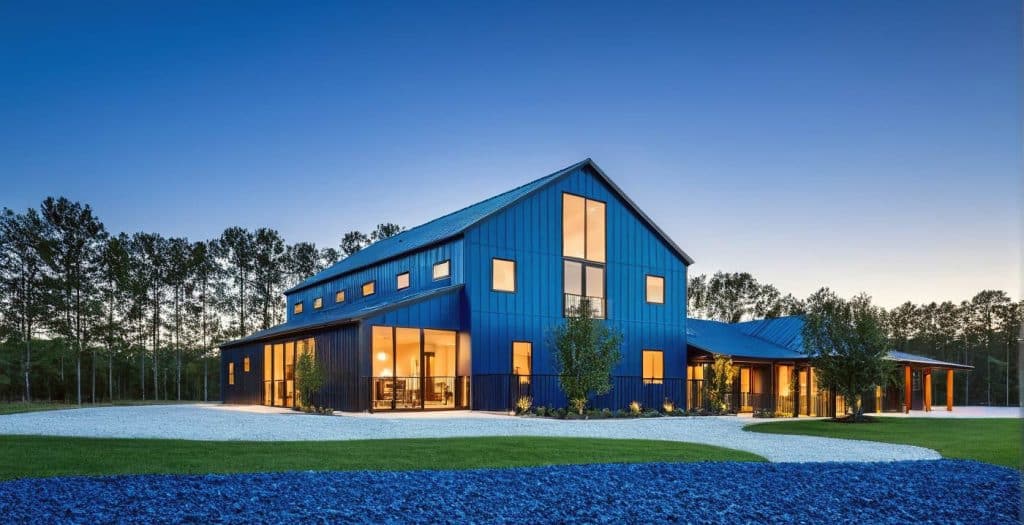
Alabama’s barndominium industry is booming and offers great opportunities for barndominium builders. The state’s affordable land prices make it easier to find a suitable plot for construction.
The climate in Alabama is favorable for barndos. Mild winters reduce heating costs, while the sturdy metal structures withstand summer heat and storms.
Are You A Barndominium Builder in Alabama? Feature Your Best Build Here
We work with a small number of barndominium builders in each region — not a directory, and not one company per state. If you build barndominiums in Alabama and want your projects in front of homeowners who are actively looking, we would like to see your work.
Send us two to three completed builds, the regions you serve, and your license details. We review every submission and reply either way.
Are you an Alabama barndominium builder who’d like to be listed here? Get in touch.
Start with a floor plan
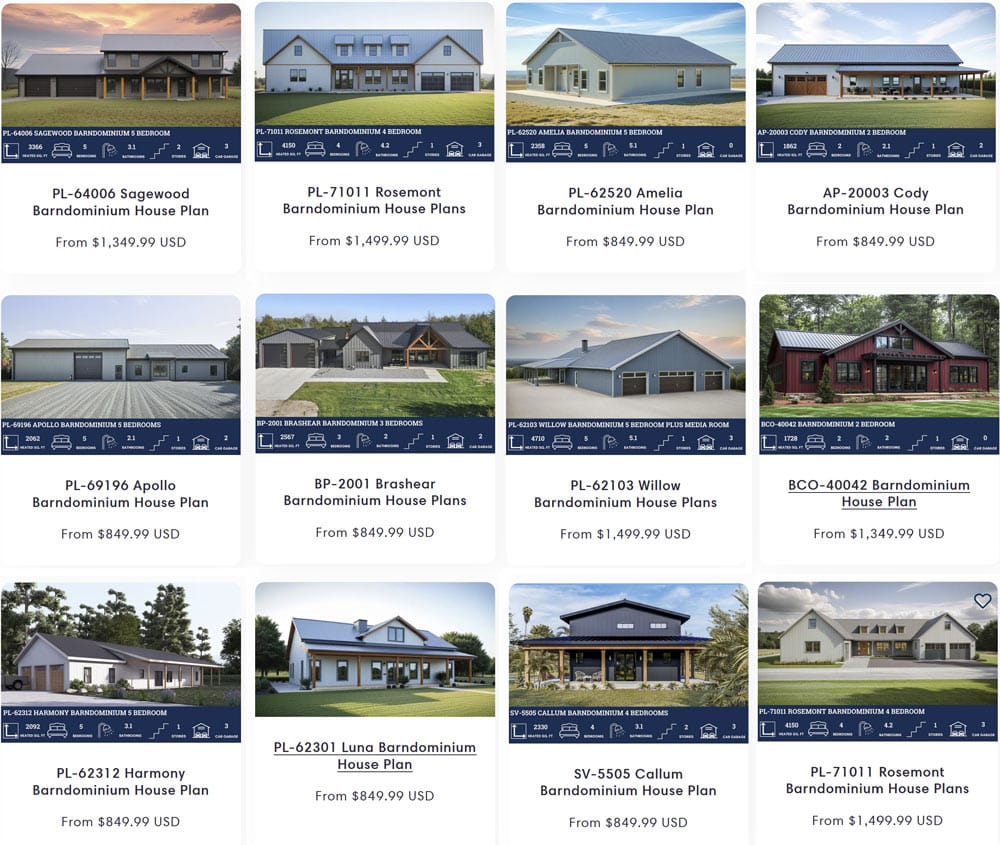
Most Alabama projects start with a plan, then get matched to a local builder or kit. You can browse hundreds of ready-to-build barndominium designs — filtered by size and bedroom count, many with a safe room — and customize any of them to your lot:
Browse barn home floor plans →
Popular starting points: the 40×60 (2,400 sq ft) — the most-built size in Alabama — the compact 40×40, or the roomy 50×60. You can also shop by bedroom count, from 3-bedroom family plans to 4-bedroom layouts with a shop.
Alabama Barndominium Plans Best Sellers
How much does it cost to build a barndominium in Alabama?
Alabama runs at or below the national average thanks to cheap land and low labor costs — with the Gulf Coast the exception, where wind engineering and FORTIFIED construction add to the total. All of the figures below come from our barndominium cost guide, which has the full breakdown and a calculator:
| Build stage | Cost per sq ft | What it includes |
|---|---|---|
| Kit materials only | $20 – $35 | Steel or SIP shell package, delivered |
| Shell, erected | $30 – $50 | Kit up, dried-in, on your slab |
| Finished — standard | $65 – $120 | Move-in ready, mid-grade finishes |
| Finished — high-end | $130 – $200 | Premium finishes, custom details |
For a popular 40×60 (2,400 sq ft) build at a standard finish, that’s roughly $156,000–$288,000 turnkey, with most owner-directed projects landing in the middle. A kit covers the shell only — budget the slab, interior, and site work separately. Metro areas like Birmingham and Huntsville tend to run a bit higher than rural counties, and coastal Mobile/Baldwin builds carry a wind-engineering premium.
A word on shopping kits: avoid packages priced below about $20 per square foot. Those are usually agricultural-grade barn kits, not engineered for residential occupancy or your wind zone — a real problem on the coast. Beyond the shell and finishes, budget for land, site prep and a slab, the well and septic, utility hookups, and a driveway/culvert — the cost guide breaks each one down.
How long does it take to build?
Plan on 6–12 months end to end: design and engineering (2–4 weeks), kit fabrication (6–10 weeks), shell erection (2–4 weeks), and interior finishing (3–5 months). The septic permit and (in coastal or incorporated areas) plan review are the usual variables — start the soil evaluation early since it can gate everything else.
Financing
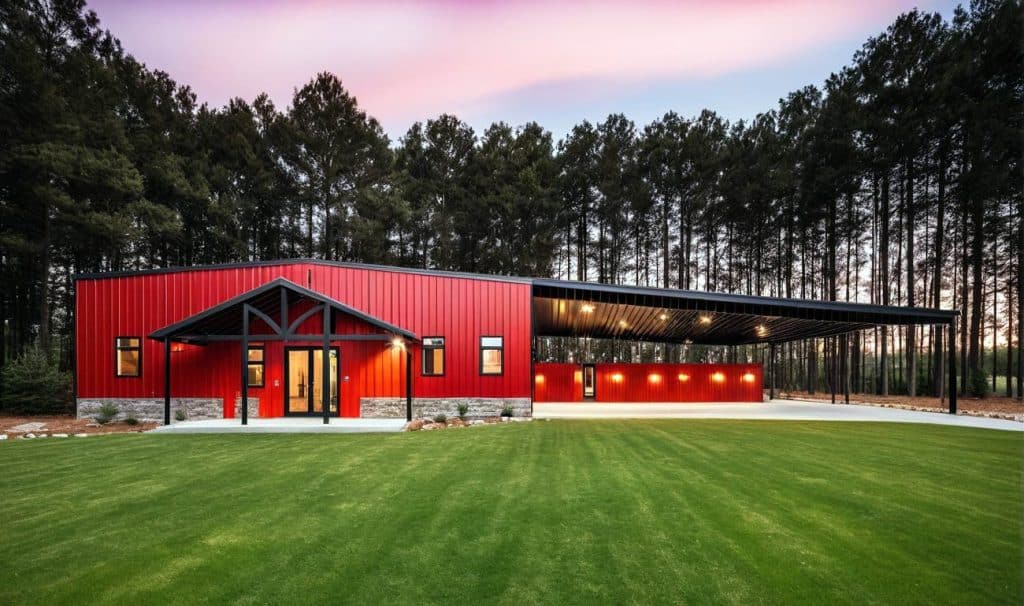
Financing is very doable in Alabama, with the appraisal being the usual sticking point — so line up the right lender early. USDA Rural Development loans (often $0 down) cover much of rural Alabama and are one of the best tools for a country build. Construction-to-permanent loans are the standard route for a build; VA loans and Farm Credit lenders are worth checking for veterans and larger rural parcels. Many Alabama builders also have lending partners familiar with barndominium appraisals.
Two tips that matter here: use a lender who has actually financed barndominiums before (local Alabama lenders usually move faster than national banks), and insist on an appraiser with barndominium experience so your home isn’t undervalued as a “metal building.” Our full barndominium financing guide walks through loan types, the appraisal issue, and how to prepare. (General information, not financial advice.)
Alabama barndominium FAQ
Are barndominiums legal in Alabama? Yes, statewide. They’re built as residential dwellings, and Alabama is one of the friendlier states for them thanks to light code enforcement in rural areas. In many unincorporated counties there’s no building permit or inspection at all, while cities enforce the 2015 IRC. Electrical/plumbing licensing and a county septic permit still apply almost everywhere — always confirm with your county first.
Do I need a building permit for a barndominium in Alabama? It depends entirely on location. Incorporated cities with building departments require permits and inspections; many rural, unincorporated counties don’t enforce residential building codes at all. Even where no building permit is needed, you’ll still need a septic permit from the county health department and licensed electrical/plumbing work.
What’s different about building on the Gulf Coast? Mobile and Baldwin counties enforce much stricter wind codes (up to ~140–150 mph) after Katrina. Building to the FORTIFIED standard is strongly recommended — Alabama requires insurers to discount FORTIFIED homes, and the Strengthen Alabama Homes grant offers up to $10,000 toward a FORTIFIED roof. Budget for wind-rated engineering if you build near the coast.
How much does a barndominium cost in Alabama? Most finish out at $65–$120 per square foot turnkey (standard finish) — roughly $156,000–$288,000 for a 40×60 — with a shell kit alone at $20–$35 per square foot in materials. Coastal wind engineering adds to that. See the cost guide.
Do I need a soil test before buying land in Alabama? Effectively, yes — make a soil/site evaluation a contingency of any rural land purchase. ADPH and your county health department use it to decide whether the lot will support a septic system, what type, and how many bedrooms you can permit. A failed evaluation can mean a $15,000–$30,000+ engineered system or an unbuildable lot.
Should I put a storm shelter in my Alabama barndominium? It’s one of the smartest upgrades you can make. Alabama’s “Dixie Alley” tornadoes are frequent, violent, and often strike at night. A safe room built to FEMA P-361 / ICC 500 standards — interior reinforced or below-slab — is well worth it, and many floor plans include one.
Ready to build your Alabama barndominium?
Start with a floor plan — browse designs sized for your lot and budget. Shop barndominium floor plans →
Work out your budget — see our full cost guide →
Compare your options — a steel kit, a prefab SIP shell, or a local builder. Get started →
This page is for general informational purposes and isn’t a substitute for confirming requirements with your county and city building offices, your county health department, a licensed contractor, or a mortgage professional. Codes, costs, and local ordinances change — verify current requirements for your parcel before you build.
If you would like to add your business to our state guides or run a feature profile on our site please contact us below. Please send your featured build images, project details and company history to us.
If you would like to add your business to our state guides or run a feature profile on our site, contact us below. Please send your featured build images, project details and company history to us.
This page is for general informational purposes and isn't a substitute for confirming requirements directly with your county's building and zoning office, a licensed state contractor, or a mortgage professional.
We Offer 3 Paths To Get Started
Choose Your Floor plan
Choose from over 1,200 ready-to-build stock plans, available for instant download. Most stock plans can be modified to fit your specific lot starting at $400.
Best for: Residential Homes – Ready To Build
CREATE Your CUSTOM DESIGN
Have your plan drawn to fit your lot and your exact layout — no compromises. $2 per square foot for heated/living areas and $0.50 for unheated spaces.
Best for: Residential Homes – Complete Design Control
Start With A Kit
Steel kits are best for DIY customers, commercial buildings, workshops, or those looking for max savings. They are delivered to you, and you or your contractors erect the kit.
Best for: DIY Customers, Shop Houses & Garages