

Tennessee is one of the best states in the country to build a barndominium. Land is affordable, much of the state is rural with light or no zoning, and — unusually — Tennessee lets counties and cities opt out of the state residential building code entirely, so in large parts of the state you’re building with a remarkably free hand. Add low wind loads and no state income tax, and it’s easy to see why Middle Tennessee in particular has become a barndominium hotspot.
There are two things that make Tennessee different from its neighbors, and both shape your project from day one: the opt-out code structure that varies county to county, and the New Madrid Seismic Zone, which drives real engineering requirements in West Tennessee. This guide covers both, plus current codes, septic and permitting, realistic 2026 costs, vetted Tennessee builders, and how to finance the build.
Does Tennessee have a statewide building code?
Yes — but with a big asterisk that makes Tennessee genuinely different. The state residential code is the 2018 International Residential Code (IRC) paired with the 2018 International Energy Conservation Code (IECC), administered by the State Fire Marshal’s Office (SFMO). Your barndominium is built and inspected as a one- or two-family dwelling under the IRC — not as a barn.
The asterisk is the opt-out. The state code and its inspections apply only where a jurisdiction hasn’t stepped outside it. A city or county can either (a) be exempt because it enforces its own local building codes, or (b) formally opt out of the state residential code and inspections by a two-thirds vote of its legislative body. The SFMO maintains the running list of these “non-code” and opt-out jurisdictions. The practical result: whether the state residential inspector shows up at your build depends entirely on which county you’re in, so the first call you make should be to the county building/codes office to find out which regime applies to your parcel.
One point that trips up owner-builders: even in an area covered by the state code, a homeowner building their own home isn’t automatically exempt. To qualify, the home must be your own residence (not built to sell or lease) and you can’t have been issued a homeowner building permit in the prior 24 months. And regardless of code jurisdiction, electrical permits and inspections still apply nearly everywhere — that’s the one thing you can’t skip.
Finally, if you’re hiring it out: Tennessee requires a licensed contractor for any project of $25,000 or more (including materials and labor). Confirm your builder holds the right classification with the Tennessee Board for Licensing Contractors before you sign.
No agricultural exemption for a home
Because so much of Tennessee is rural, people assume they can build “a barn” and move in. You can’t — not legally. A structure used as a residence is a dwelling, and it has to be permitted as one wherever the residential code applies. In opt-out counties there may be no state building inspection, but that doesn’t turn your home into a farm building: you still need electrical permits, a septic permit, and — for a mortgage or insurance — a home that was built to residential standards. Building “as agricultural” and living in it is how people end up unable to insure, finance, or sell the place later.
Wind is low — seismic is the real design driver
Here’s some good news for your budget: Tennessee has low design wind speeds by national standards — roughly 115 mph (ultimate) under ASCE 7-16 across most of the state, well below what coastal states require. That means lighter framing and simpler anchorage than a comparable build in Texas or Florida, and it’s one reason turnkey costs here run reasonable.
The requirement that does matter in Tennessee is seismic, and it’s the single most important engineering fact for West Tennessee builders.
Septic, wells, and soil testing
Most rural Tennessee barndominiums run on a private well and septic system, and the septic permit is often the gating item on a rural lot. Subsurface sewage disposal (SSD) systems are permitted through the Tennessee Department of Environment and Conservation (TDEC), Division of Water Resources — though a few counties (such as Knox and Shelby) run septic through their local health departments.
The step that protects your budget is the soil site evaluation before you buy the land. A TDEC-approved soil scientist or the local office evaluates the soil to determine whether the parcel will support a septic system, what type you need, and how many bedrooms you can permit — septic sizing is tied to bedroom count, which directly caps how large a home you can build on that lot.
Budget by result. A conventional gravity system on good soil commonly runs $5,000–$12,000. Tight clay soils, shallow bedrock (common in parts of Middle and East Tennessee), or a high water table can require an engineered or alternative system (pump, drip, or aerobic), running $15,000–$30,000+. Never close on rural land without a soil-evaluation contingency — a lot that won’t perc can quietly kill the whole plan.
Building Codes: What Actually Applies
Urban and designated conservation areas are where you’re most likely to run into real restrictions — if you’re building near Nashville, Knoxville, Chattanooga, or Memphis city limits, check local zoning before you buy land, not after.
Zoning is minimal to nonexistent in many rural and unincorporated areas. In these areas, you can generally use land however you wish, and permits often aren’t required for the structure itself.
Permits are still required for grid-tied electrical hookups and septic systems, even in areas with no general building permit requirement.
Many counties and cities have opted out of the state’s residential inspection program. In these jurisdictions, your barndo doesn’t need a formal inspection to be occupied — though you can request one voluntarily, and doing so can help with insurance and resale later.
A contractor license is required for any project over $25,000. This threshold catches nearly every barndo build, so confirm your builder or contractor holds a current Tennessee license, and confirm licensed professionals are handling electrical, plumbing, and HVAC regardless of whether the county requires an inspection.
Many counties and cities in TN have opted out of the residential inspection program, which means that you can build your barndominium without having to worry about inspections.
You can request one if you’d like, but it’s not required
The cities and counties that have opted out include:
- Bledsoe County
- Benton County: Big Sandy (city)
- Auburntown (city)
- Carroll County: Atwood (city)
- Claiborne County
- Cocke County
- Decatur County
- Dowelltown (city)
- Slayden (city)
- Vanleer (city)
- Fentress County
- Franklin County
- Ardmore (city)
- Minor Hill (city)
- Grainger County: Rutledge (city)
- Grundy County
- Hardin County: Crump (city)
- Henderson County: Sardis (city)
- Henry County: Puryear (city)
- Houston County
- Humphreys County
- Jackson County
- Johnson County
- Lake County: Ridgely (city), Tiptonville (city)
- Gates (city)
- Lawrence County
- Lewis County
- McMinn County: Calhoun (city)
- McNairy County: Michie (city), Stantonville (city)
- Monroe County
- Moore County/Lynchburg
- Morgan County
- Obion County
- Overton County
- Perry County
- Pickett County
- Scott County
- Sequatchie County
- Burlison (city)
- Unicoi County
- Van Buren County
- Wayne County
- Weakley County
Many other counties and cities in the state have an exemption for the State Residential Building Program.
In other words, it’s relatively easy to build a barndo in most areas of Tennessee.
Urban and conservation areas are the primary areas of the state where building restrictions will come into play if you want to build a barndominium.
Seismic Risk: The Detail Most Guides Skip
If you’re building in West Tennessee, this matters more than almost anything else on this page. The New Madrid Seismic Zone runs through the western part of the state, and counties in that region carry a Seismic Design Category of C or D1 — a meaningfully higher design standard than the rest of the state.
This affects:
- Foundation design
- Frame connections
- Lateral bracing
- Anchor bolt specifications
If your builder is quoting a standard barndo package without mentioning seismic detailing and you’re building west of the Tennessee River, ask directly whether their engineering accounts for it. A kit designed for East Tennessee’s terrain won’t automatically meet West Tennessee’s seismic requirements.
What this means in practice: if you’re building in West Tennessee, budget for a stamped engineered foundation and don’t buy a generic kit off the shelf. The steel or SIP shell has to be engineered for your site’s seismic category, and skimping here is both dangerous and a code violation. In Middle and East Tennessee, seismic demand drops off substantially and the requirements are much lighter — another reason those regions are popular for barndominiums. Wherever you build, have your engineer confirm the seismic design category for your specific address.
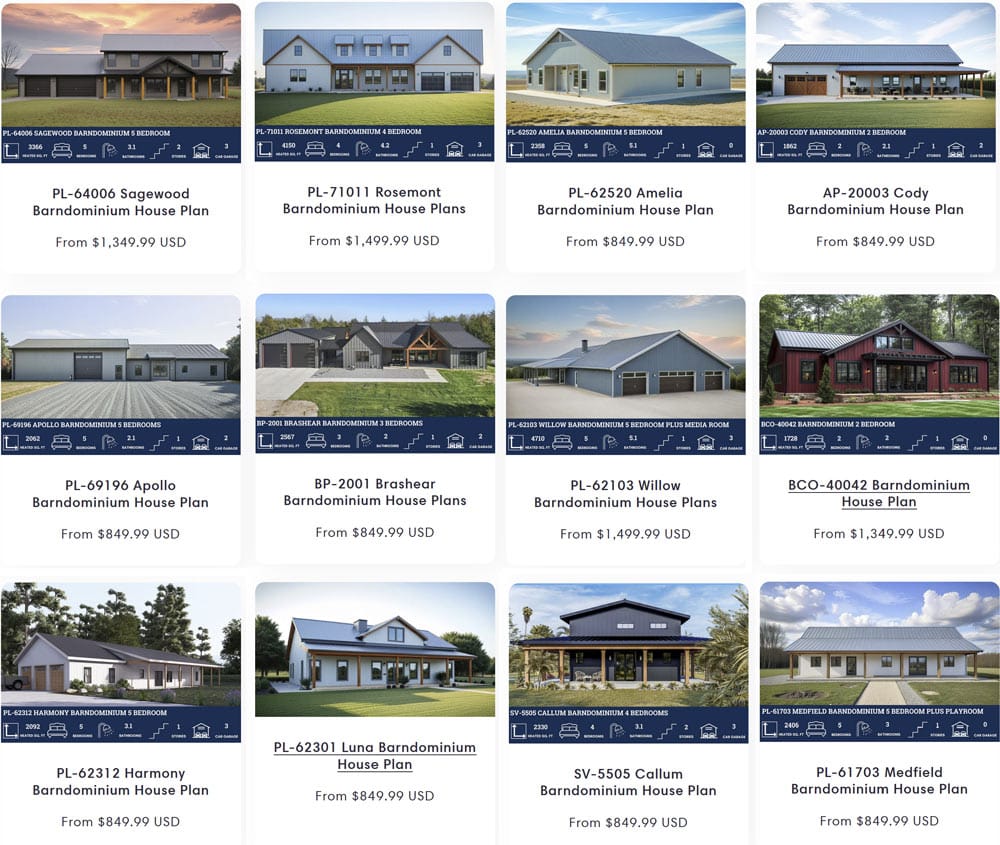
Barndominiums In Tennessee: Best-Selling Floor Plans
Climate: Tennessee Isn’t One Climate Zone
Tennessee’s geography splits meaningfully into two design considerations:
- East Tennessee (Smokies, Knoxville, Chattanooga area): humid subtropical climate with colder winters and higher rainfall. This side of the state generally calls for more robust insulation and moisture-resistant materials.
- West Tennessee (Memphis and the Mississippi River corridor): milder winters, hotter and more humid summers. Cooling capacity and heat-resistant materials matter more here than insulation depth.
If a builder is quoting the same spec sheet regardless of which end of the state you’re in, that’s worth a follow-up question.
Tornado activity is also a statewide consideration and has been increasing in frequency — ask about wind design details (anchor bolts, hurricane ties, impact-rated openings) regardless of which region you’re building in.
Tennessee Barndominium Builders: How To Choose One

Tennessee licenses contractors at a low enough threshold that every barndominium is covered, which means barndominium builders in Tennessee must be licensed before they even bid on your project. The license carries two details worth reading beyond its status: the classification, and the monetary limit.
Tennessee’s $25,000 Rule, And Why It Applies Before The Bid
Tennessee licenses contractors through the Tennessee Board for Licensing Contractors, under the Department of Commerce and Insurance, and the threshold is low enough that it catches every barndominium: a contractor license is required for work of $25,000 or more.
The classification to look for on a barndominium is BC-A (Residential), which covers building, repair, remodeling and improvement of residential structures of three stories or less.
There is a second tier below that. Projects between $3,000 and $25,000 require a Home Improvement license in nine specific counties: Bradley, Davidson, Hamilton, Haywood, Knox, Marion, Robertson, Rutherford and Shelby. That will not cover your barndominium, but it matters for the additions and outbuildings that often follow one.
Each Tennessee license also carries a monetary limit set by the board based on the contractor’s financial statement. As in North Carolina, confirm that limit covers your contract value rather than assuming the license alone is enough.
Verify the license, classification, monetary limit and status through the Board for Licensing Contractors at tn.gov before you sign.
Thresholds, classifications and the list of Home Improvement counties are set by the board and can change. Confirm current requirements with the Tennessee Board for Licensing Contractors, and check your county for local requirements on top.
How To Vet A Tennessee Barndominium Builder
Pull the license and read the monetary limit, not just the status. A contractor whose limit sits below your contract value is a licensing problem that becomes your delay.
Confirm the classification is BC-A or broader. A license in an unrelated classification does not authorize building your home.
Confirm insurance directly with the agent — general liability and workers’ compensation.
Ask for three completed barndominiums, and at least one in your grand division. Tennessee runs 440 miles east to west across markedly different climate and terrain, and a West Tennessee builder and an East Tennessee builder are not solving the same problems.
Ask what seismic design category the site falls in, and who sealed the drawings. West Tennessee sits near the New Madrid seismic zone, and seismic — not wind — is the governing structural question across much of the state. A builder who has never been asked this and cannot answer it has not built many engineered structures here.
Ask about the soil test and septic permit sequence on rural land, where it governs siting.
What To Ask Before You Sign
Does your contract value sit inside their license’s monetary limit?
What seismic design category did the engineer use, and can you see the sealed drawing?
How is the draw schedule structured, and does each draw follow a passed inspection?
Who pulls the permits?
What do the allowances cover, in dollars and specification?
What happens if steel prices move? Escalation clause in writing, with a cap and a price-hold period.
How are change orders priced and approved? Written, signed, priced before work proceeds.
Red Flags In A Tennessee Quote
- No license number on the written estimate. Tennessee contractors are required to be licensed before bidding at this value, so a bid without one raises a question about the bid itself.
- A monetary limit below your contract value, presented as a technicality.
- The wrong classification for residential building.
- No seismic design mentioned, particularly anywhere in West or Middle Tennessee.
- A large deposit before materials are ordered.
- Verbal allowances.
- Metal building experience offered in place of dwelling experience. An unconditioned shell and a finished home are different projects.
Owner-Builder Or General Contractor In Tennessee?
Tennessee’s owner-builder provisions allow a homeowner to build a residence they will occupy, with conditions and with restrictions on selling afterwards. Because the licensing threshold is $25,000, the state’s expectation of a licensed professional kicks in well below the cost of any barndominium — which makes the owner-builder route a more deliberate departure here than in a state with no licensing at all.
Financing is the practical constraint. Construction lenders are cautious with owner-builder projects and several decline them. And if the site is in a seismic design category that requires engineered detailing, you are personally taking on responsibility for getting that right.
Owner-builder rules are set at state level and applied locally. Confirm with the Tennessee Board for Licensing Contractors and your county building department before deciding.
Are you a Tennessee barndominium builder who’d like to be listed here? Get in touch.
Start with a floor plan
Most Tennessee projects start with a plan, then get matched to a local builder or kit. You can browse hundreds of ready-to-build barndominium designs — filtered by size and bedroom count — and customize any of them to your lot:
Browse barndominium floor plans →
Popular starting points: the 40×60 (2,400 sq ft) — the most-built size in Tennessee — the compact 40×40, or the roomy 50×60. You can also shop by bedroom count, from 3-bedroom family plans to 4-bedroom layouts with a shop.
Tennessee climate and moisture
Tennessee’s humid summers and real winters mean you should insulate above the 2018 IECC minimum, not to it. A metal building in this climate depends on its vapor barrier and insulation detailing: closed-cell spray foam or SIPs, a proper vapor retarder, and a right-sized HVAC system with good dehumidification are what keep a Tennessee barndominium comfortable and condensation-free. East Tennessee’s mountains see colder winters and more heating load; West Tennessee runs hotter and more humid — build for your region.
How Much Does It Cost to Build a Barndominium in Tennessee?
Tennessee generally sits at or a little below the national average, helped by affordable land, low wind loads, and competitive labor. All of the figures below come from our barndominium cost guide, which has the full breakdown and a calculator:
| Build stage | Cost per sq ft | What it includes |
|---|---|---|
| Kit materials only | $20 – $35 | Steel or SIP shell package, delivered |
| Shell, erected | $30 – $50 | Kit up, dried-in, on your slab |
| Finished — standard | $65 – $120 | Move-in ready, mid-grade finishes |
| Finished — high-end | $130 – $200 | Premium finishes, custom details |
For a popular 40×60 (2,400 sq ft) build at a standard finish, that’s roughly $156,000–$288,000 turnkey, with most owner-directed projects landing in the middle. A kit covers the shell only — budget the slab, interior, and site work separately.
Two Tennessee-specific cost notes. First, if you’re building in the West Tennessee seismic zone, add for the engineered foundation and connection detailing — it’s real money and it’s not optional. Second, avoid kits priced below about $20 per square foot; those are usually agricultural-grade packages, not engineered for residential occupancy or your seismic category, and you’ll pay to fix that later. Beyond the shell and finishes, budget for land, site prep and a slab, the well and septic, utility hookups, and a driveway/culvert — the cost guide breaks each one down.
Realistic Build Timeline In The Volunteer State
Plan on 6–12 months end to end: design and engineering (2–4 weeks), kit fabrication (6–10 weeks), shell erection (2–4 weeks), and interior finishing (3–5 months). Owner-directed builds and the septic/permit timeline are the usual variables — start the soil evaluation and septic permit early, since those can gate everything else.
The timeline broken down roughly looks like:
| Phase | Typical duration |
|---|---|
| Design & engineering | 2–4 weeks |
| Kit production (foundation work often happens concurrently) | 6–10 weeks |
| Shell erection | 2–4 weeks |
| Interior finish | 3–5 months |
Permitting speed varies enormously by location: rural counties may issue permits in a matter of days, while Nashville-area counties can take several weeks. Build this into your timeline expectations before you lock in a move-in date.
Financing
Financing is very doable in Tennessee, with the appraisal being the usual sticking point — so line up the right lender early. USDA Rural Development loans (often $0 down) cover much of rural Tennessee and are one of the best tools for a country build. Construction-to-permanent loans are the standard route for a build; VA loans and Farm Credit lenders are worth checking for veterans and larger rural parcels.
Two tips that matter here: use a lender who has actually financed barndominiums before (builder-affiliated and local Tennessee lenders usually move faster than national banks), and insist on an appraiser with barndominium experience so your home isn’t undervalued as a “metal building.” Our full barndominium financing guide walks through loan types, the appraisal issue, and how to prepare. (General information, not financial advice.)
Working With a Local TN Builder
Given how much enforcement and climate requirements vary by region, a builder with recent experience in your specific part of the state is worth more than a generalist. When vetting a Tennessee builder, ask:
- Whether they’ve built in your county recently, and whether they know your local permitting office
- Whether their engineering accounts for seismic detailing if you’re in West Tennessee
- For references or photos from completed local projects — not just plan renderings
Tennessee barndominium FAQ
Are barndominiums legal in Tennessee?
Yes, statewide. They’re permitted and built as residential dwellings under the 2018 IRC where the state code applies. Many rural counties have opted out of the state residential code or have light zoning, but electrical permits and a septic permit are still required almost everywhere. Always check with your county codes office first.
Which Tennessee counties don’t require building inspections?
Many rural counties have opted out of the state residential building code by a two-thirds vote of their legislative body, and others are exempt because they enforce local codes instead. The State Fire Marshal’s Office maintains the current list of opt-out/non-code jurisdictions — confirm your specific county before you rely on it, and remember electrical permits still apply.
Do I need a special foundation in West Tennessee?
Often, yes. West Tennessee sits in the New Madrid Seismic Zone, where buildings commonly fall into Seismic Design Category C or D. That requires an engineered foundation and stronger frame connections. Budget for stamped engineering and don’t use a generic kit if you’re building in the Memphis area or the northwest counties.
How much does a barndominium cost in Tennessee?
Most finish out at $65–$120 per square foot turnkey (standard finish) — roughly $156,000–$288,000 for a 40×60 — with a shell kit alone at $20–$35 per square foot in materials. West Tennessee seismic engineering adds to that. See the cost guide.
Can I build a barndominium myself in Tennessee?
Yes, and Tennessee is friendlier than most to owner-builders, but there are rules: a homeowner building their own residence must not build it to sell or lease and can’t have pulled a homeowner permit in the prior 24 months, and any project of $25,000+ that you hire out needs a licensed contractor. Electrical work still requires permits and inspection.
Do I need a soil test before buying land in Tennessee?
Effectively, yes — make a soil site evaluation a contingency of any rural land purchase. It determines whether the lot will perc, what septic system you need, and how many bedrooms you can permit. A failed perc can mean a $15,000–$30,000+ engineered system or an unbuildable lot.
Who Are The Best Barndominium Builders In Tennessee?
We do not publish a ranked list. Tennessee runs 440 miles east to west across different terrain, climate and seismic conditions, so the right builder is a regional question. Verify an active license in the BC-A Residential classification, check that its monetary limit covers your contract value, and ask which seismic design category your site falls in — a builder who cannot answer that has not built many engineered structures in this state.
Ready to build your Tennessee barndominium?
Start with a floor plan — browse designs sized for your lot and budget. See barndominium floor plans →
Work out your budget — see our full cost guide →
Compare your options — a steel kit, a prefab SIP shell, or a local builder. Get started →
This page is for general informational purposes and isn’t a substitute for confirming requirements with your county building and codes office, TDEC or your local health department, a licensed contractor, or a mortgage professional. Codes, costs, and local ordinances change — verify current requirements for your parcel before you build.
If you would like to add your business to our state guides or run a feature profile on our site please contact us below. Please send your featured build images, project details and company history to us.
If you would like to add your business to our state guides or run a feature profile on our site, contact us below. Please send your featured build images, project details and company history to us.
This page is for general informational purposes and isn't a substitute for confirming requirements directly with your county's building and zoning office, a licensed state contractor, or a mortgage professional.
We Offer 3 Paths To Get Started
Choose Your Floor plan
Choose from over 1,200 ready-to-build stock plans, available for instant download. Most stock plans can be modified to fit your specific lot starting at $400.
Best for: Residential Homes – Ready To Build
CREATE Your CUSTOM DESIGN
Have your plan drawn to fit your lot and your exact layout — no compromises. $2 per square foot for heated/living areas and $0.50 for unheated spaces.
Best for: Residential Homes – Complete Design Control
Start With A Kit
Steel kits are best for DIY customers, commercial buildings, workshops, or those looking for max savings. They are delivered to you, and you or your contractors erect the kit.
Best for: DIY Customers, Shop Houses & Garages