

Michigan is one of the better states in the country to build a barndominium. Land is affordable outside the southeast corner, post-frame construction is a native building tradition rather than a novelty, and building departments here have been looking at pole buildings for generations.
But there’s a trap in Michigan law that catches more barndominium buyers than anything else, and it comes disguised as good news: the state’s agricultural building exemption. Understand it before you do anything else, because getting it wrong can mean a stop-work order, daily fines, a denied insurance claim, or in the worst cases an order to tear the building down.
Here’s what actually applies in Michigan — the exemption, the snow loads, the frost depth, and the septic situation that makes this state genuinely unlike any other.
Michigan Barndominium Plans

The agricultural exemption — and the trap inside it
Michigan has one of the most generous agricultural building exemptions in the country. It’s real, it’s written into statute, and it does not cover a house.
What the exemption actually says
Under the Stille-DeRossett-Hale Single State Construction Code Act (MCL 125.1501 et seq), a building permit is not required for a building incidental to the agricultural use of the land it sits on, provided the building isn’t used in the business of retail trade (MCL 125.1510(8)).
Michigan goes further than most states here. The Act excludes agricultural buildings from the very definitions of “building” and “structure” in the code (MCL 125.1502(a)) — so an exempt farm building isn’t just permit-free, it sits outside the construction code’s scope altogether. In many Michigan counties, an agricultural building needs only a land use permit, frequently free or under $100.
The retail trade limit is the boundary most people meet first: a barn built to store hay is exempt; convert that same barn into a farm store selling directly to the public and it isn’t.
Why it doesn’t help your barndominium
Living quarters require residential permits regardless of the agricultural exemption.
This is the single most important sentence on this page. The moment your structure contains a dwelling, the residential code applies in full — egress, electrical, plumbing, insulation, inspections, all of it. It doesn’t matter that the other 60% of the building is a legitimate workshop or equipment store. It doesn’t matter that the parcel is zoned agricultural. It doesn’t matter that your neighbour’s pole barn went up without a permit.
Michigan post-frame builders are direct about this, and the good ones will refuse the job if you ask them to treat a barndominium as an exempt farm building. The failure modes are well documented:
- A neighbour reports the build to the township, and the building department posts a stop-work notice
- Construction halts until a permit is obtained, often with fees doubled as a penalty
- Daily fines while you’re non-compliant
- Concealed work has to be opened up for inspection, which can cost more than the original work
- Insurance denial — if you have a fire or a claim in an unpermitted dwelling, your carrier may have grounds to walk away
- Resale problems — unpermitted living space is a title and disclosure issue that will surface at closing
- In extreme cases, an order to remove the structure entirely
The legitimate version of this is straightforward: if you’re genuinely farming and building a genuine farm building, use the exemption. If you’re building somewhere to live, pull the permit. A few hundred dollars is cheap next to the alternative.
Worth watching: House Bill 5056, introduced in the 2025–2026 legislative session, proposes changes to permit exemptions under the Act. Check its current status of the bill before any building starting in 2027 or later.
Our Picks For Top Barndominium Builders In Michigan
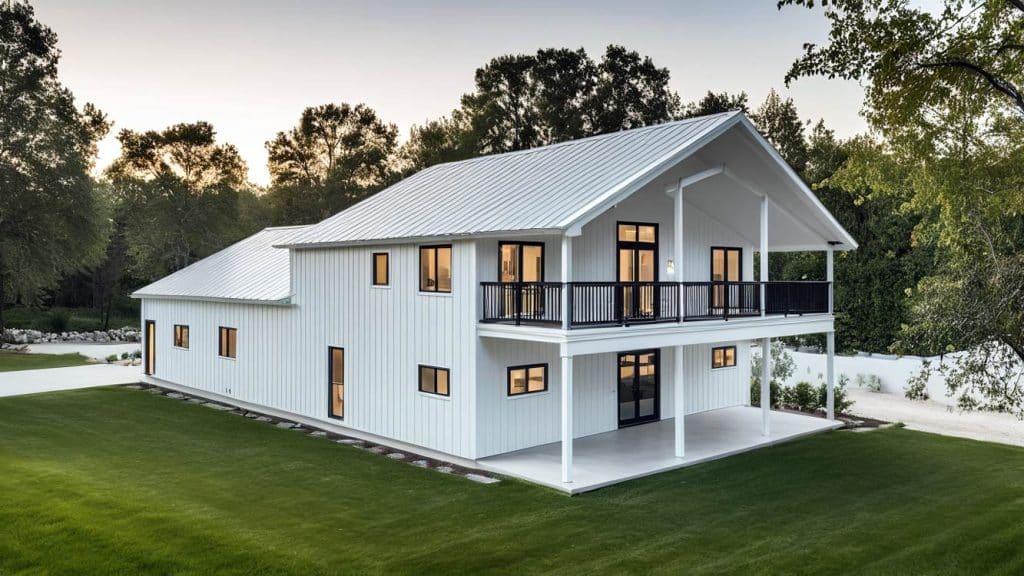
When it comes to building a barndominium, choosing the right builder is crucial. A licensed builder with experience in constructing barndominiums can ensure that the project is completed on time, within budget, and to your satisfaction.
Here are some of the top barndominium builders in Michigan to consider:
Blue Ox Barns
6020 M72 E
Kalkaska, MI 49646
231-384-1451
https://blueoxbarns.com/
Blue Ox Barns is a reputable barndominium builder in Michigan that specializes in custom designs. They offer a wide range of options, including post-frame construction, traditional stick-built construction, and hybrid designs. They also provide a 10-year structural warranty on all their projects.
Orchard Construction
73261 South Fulton
Armada, Michigan 48005
586-784-545
https://post-frame.com/
Orchard Construction is a licensed builder that has been in business for over 30 years. They have experience in building barndominiums and can provide custom designs to meet your needs. They also offer a 5-year warranty on all their projects.
Morton Buildings
252 W. Adams St.
Morton, IL 61550-1804
309-263-3680
https://mortonbuildings.com/
Morton Buildings is a national builder that has been in business for over 100 years. They have a reputation for quality construction and excellent customer service. They offer a variety of building styles, including barndominiums, and can customize their designs to meet your specific needs.
Milmar Post Buildings
7657 IN-2
La Porte, IN 46350
260-440-3190
https://www.milmarpolebuildings.com/
Milmar Post Buildings is a Indiana-based builder that covers Michigan. They specialize in post-frame construction. They have experience in building barndominiums and can customize their designs to meet your unique requirements. They also offer a 5-year workmanship warranty on all their projects.
Permits, townships, and county variation
Michigan operates under a single state construction code, which is genuinely helpful — the baseline residential requirements are consistent statewide rather than reinvented in every jurisdiction. The Michigan Residential Code governs detached one- and two-family dwellings up to three stories.
Enforcement, though, is local, and Michigan townships hold unusually strong land-use authority compared with most states. Zoning, setbacks, minimum square footage, exterior appearance standards, and whether a metal-clad residence is permitted at all are decided at the township or county level.
Before you buy land, call the township office as well as the county building department and ask:
- What zoning applies to this parcel, and is a post-frame or metal residence permitted?
- Is there a minimum dwelling size or exterior material standard?
- Which agency issues the building permit here — township, county, or the state?
- What’s the ground snow load figure used for this address?
- Which health department handles septic and well permits, and what are their rules?
That last two matter more in Michigan than almost anywhere, for reasons covered below.
Snow load and frost depth — what Michigan’s climate does to your build
This is where a Michigan barndominium genuinely costs more than the same building in Tennessee, and it’s worth understanding rather than being surprised by.
Ground snow load
Michigan’s design ground snow loads are among the highest in the lower 48, and they vary enormously within the state:
| Region | Typical design ground snow load |
|---|---|
| Southern counties | roughly 20–30 psf |
| Mid-state (East Lansing area) | minimum 30 psf |
| Lake-effect zones, western shore | substantially higher |
| Upper Peninsula and northern lake-effect belts | up to 70 psf in places |
Snow load varies by ZIP code, not by region, and your truss package has to be engineered to the actual figure for your address. A truss package designed for 30 psf will not pass plan review in Marquette County. This is the most common way an out-of-state kit quote turns out to be meaningless once it reaches a Michigan building department.
Ask any supplier quoting you a price which snow load their package is engineered for. If they can’t answer, or if they haven’t asked for your ZIP code, that’s your answer about the quote.
Frost depth
Michigan’s frost depth is 42 inches across most of the state, with parts of the Upper Peninsula requiring deeper. For comparison, much of the South works to 12–18 inches.
That difference cascades through your budget:
- Substantially more excavation labour than an equivalent southern build
- Power auger equipment is often necessary rather than hand digging, particularly in Michigan’s clay-heavy soils
- Post-frame column footings must extend below the frost line, or freeze-thaw cycling will heave the building over successive winters
- It cannot be waived. Inspectors verify depth at the footing inspection, and a shallow footing fails — after you’ve already paid to dig it
None of this is a reason not to build here. It is a reason to be sceptical of any per-square-foot figure quoted from a national cost guide.
Post-frame construction and the plan review problem in Michigan
Something worth knowing before you submit drawings: Michigan’s building code doesn’t map cleanly onto post-frame construction. Building officials in the state have acknowledged as much — the residential code is written around conventional foundations and stud framing, and post-frame buildings don’t fit those provisions neatly.
In practice this means plan reviewers frequently come back asking for things a stick-built plan set wouldn’t need: column load calculations, specific footing diameter and thickness for each column, and engineering justification for connections. A reviewer asking for a minimum 28-inch round by 12-inch thick footing, or load calculations per column, is a normal Michigan outcome rather than an obstructive one.
What that means for you:
- Budget for engineered drawings with truss calculations, connection details, and footing specifications. This isn’t optional here.
- Don’t assume a plan set that passed elsewhere will clear review in your county. Not from another state, and not always from the next county over.
- Choose a builder or supplier who does the engineering in-house or has a Michigan engineer they work with routinely. The ones who do will tell you your snow load before you ask.
Septic and wells — Michigan is unlike every other state
If you’re building on rural land in Michigan, this section will affect your project more than any other, and almost nobody covers it.
There is no statewide septic code
Michigan is the only state in the country without a statewide sanitary code. Septic authority was delegated to local health departments in the 1970s, and roughly 45 local health departments now write and enforce their own rules across the state’s 83 counties.
The practical consequence is stark: a septic system that is perfectly legal in one county can violate the code in the county next door. There is no state standard to fall back on, no uniform minimum, and no single document you can read to know what’s required. The only reliable source is the health department for your specific parcel.
Michigan has roughly 1.3 million septic systems, and only 11 of its 83 counties currently require inspections at all — among them Oakland, Washtenaw, Kent, Livingston, Mackinac, Grand Traverse, and Ingham — with most of those triggered only when a property is sold. A growing number of communities have adopted Time of Sale/Transfer (TOST) ordinances requiring inspection before a property changes hands.
Soil varies as much as the rules
Michigan’s geology differs dramatically across the state, which is part of why the local approach has survived: the sandy glacial soils of northern Michigan drain very differently from the dense clay around Detroit, and the thin bedrock soils of the Upper Peninsula are different again.
Get a percolation test before you close on land. A parcel that can’t support a conventional system isn’t unbuildable, but engineered alternatives are expensive enough to change your budget materially — and in a state with no uniform code, what your county will accept is genuinely unpredictable until you ask.
This may be changing
Senator Sam Singh introduced Senate Bill 771 in January 2026, which would require the Department of Environment, Great Lakes, and Energy (EGLE) to develop a statewide sewage code within three years, along with a state database and periodic evaluations. It went before a Senate committee in March 2026.
Similar bills have failed repeatedly over nearly four decades, so don’t plan around it passing. But if you’re building in the next few years, know that a uniform code and mandatory inspection regime is a live possibility, and building to a higher standard now is cheap insurance against it.
If you would like to add your business to our state guides or run a feature profile on our site please contact us below. Please send your featured build images, project details and company history to us.
If you would like to add your business to our state guides or run a feature profile on our site, contact us below. Please send your featured build images, project details and company history to us.
This page is for general informational purposes and isn't a substitute for confirming requirements directly with your county's building and zoning office, a licensed state contractor, or a mortgage professional.
We Offer 3 Paths To Get Started
Choose Your Floor plan
Choose from over 1,200 ready-to-build stock plans, available for instant download. Most stock plans can be modified to fit your specific lot starting at $400.
Best for: Residential Homes – Ready To Build
CREATE Your CUSTOM DESIGN
Have your plan drawn to fit your lot and your exact layout — no compromises. $2 per square foot for heated/living areas and $0.50 for unheated spaces.
Best for: Residential Homes – Complete Design Control
Start With A Kit
Steel kits are best for DIY customers, commercial buildings, workshops, or those looking for max savings. They are delivered to you, and you or your contractors erect the kit.
Best for: DIY Customers, Shop Houses & Garages