
Texas is the barndominium capital of the country, and it’s no accident. There’s no state income tax, endless rural acreage, a building culture that grew up around metal buildings — and, in much of the state, the freedom to build a home with little or no government permitting. That last part is the single biggest reason barndominiums took off here before anywhere else.
But “no building code” doesn’t mean “no rules,” and the things that actually stop or complicate Texas barndominium projects aren’t the ones people expect. They’re deed restrictions, septic siting, expansive-clay soils, and — on the coast — hurricane windstorm certification. Here’s how Texas really works in 2026, before you buy land or sign with a builder.
The Big Difference: Texas Has No Statewide Building Code Enforcement
Unlike Florida (statewide code, permits everywhere) or Georgia, Texas does not enforce a statewide residential building code. Under Local Government Code Chapter 233, counties have only limited authority to regulate construction in unincorporated areas — and most rural Texas counties do not require a building permit or inspections for a single-family home outside city limits. For a lot of people, that’s the whole appeal: you can put up a barndominium on your own rural land without a plan-review process.
Where the code does apply is inside city limits and a city’s extraterritorial jurisdiction (ETJ), where municipal building departments enforce the International Residential Code with full permits, plan review, and inspections. So the same barndominium can be nearly permit-free on unincorporated county land and fully permitted a few miles away inside a city’s ETJ. Always confirm which jurisdiction your parcel actually falls in.
And even where no building permit is required, several things are mandatory statewide:
- Septic (OSSF) permit — required anywhere you’re not on municipal sewer (more below).
- Electrical inspection — utility co-ops require a licensed inspection before they’ll energize your meter.
- Floodplain permit — if any part of the structure sits in a FEMA Special Flood Hazard Area.
- Driveway / culvert permit — for access onto a county road or state highway.
One important caveat: build to code even if no one makes you. Lenders and insurers generally expect code-compliant, properly engineered construction regardless of whether the county inspects it — and an uninspected, under-built home is hard to finance, insure, and resell. The freedom is real; use it to skip red tape, not engineering.
Deed restrictions and HOAs stop more builds than the county does
Here’s the twist that catches people: in Texas, the most common thing that kills a barndominium plan isn’t a government rule — it’s a private deed restriction. Many rural subdivisions and even large ranch tracts carry recorded restrictions that can prohibit metal-sided homes, set a minimum square footage or masonry requirement, mandate architectural review, or ban certain uses.
Deed restrictions and HOA covenants override the county’s permissiveness — a no-permit county does you no good if your tract’s deed restrictions forbid a metal home. Before you buy land, read the deed restrictions and any HOA covenants carefully (they’re recorded with the county). This is the single most overlooked step in a Texas barndominium purchase.
Where you do need permits: cities, ETJ, and stricter counties
While most rural counties are hands-off, some jurisdictions regulate more heavily, and a few counties add their own development rules even outside city limits. The clearest example is Travis County (Austin area), which enforces stormwater controls and Edwards Aquifer protections on unincorporated land, with a permitting process that can run 60–120 days. Fast-growing metro-edge counties are trending stricter over time, too.
The takeaway: the “no permit” rule is a strong general pattern, not a guarantee. Call your specific county before you assume anything — permitting can range from essentially nothing to a full city-style process depending on where you land.
Wind: mostly a coastal issue in Texas
Wind engineering in Texas is far less demanding than in Florida — for most of the state. Inland Texas designs to relatively modest wind speeds; the serious requirements are concentrated on the Gulf coast.
The Texas Department of Insurance (TDI) designates a coastal “catastrophe area” — the 14 first-tier coastal counties (Galveston, Nueces, Cameron, Brazoria, Aransas, and others) plus part of Harris County east of Highway 146. To get Texas Windstorm Insurance Association (TWIA) windstorm coverage there, new construction must earn a windstorm certificate — for engineered new builds, an engineer submits the WPI-8 certification and TDI issues a Certificate of Compliance. TDI’s windstorm program builds on the 2018 IRC/IBC and ASCE 7-16, and certification adds several weeks to your timeline, so plan for it.
Approximate design wind speeds:
| Region | Example areas | Design wind speed |
|---|---|---|
| Inland Texas (most of the state) | DFW, Austin, San Antonio, Hill Country, West Texas | ~105–115 mph |
| Coastal catastrophe area — inland zone | inland portions of the coastal counties | ~110–120 mph |
| Coastal seaward zone | Galveston, Corpus Christi, Rockport, the Brazoria coast | ~130–140+ mph |
Two other weather realities aren’t about design wind speed but do affect your build and insurance: tornadoes in North and Central Texas (a steel frame with a continuous, well-anchored load path performs better than stick framing, and many owners add a rated safe room), and hail in the DFW/North Texas corridor (impact-rated roofing pays off on insurance). Confirm your address’s design wind speed with your engineer or building official.
What it costs to build a barndominium in Texas

Texas is a competitive, builder-rich market, which keeps prices reasonable relative to coastal states — but the range is wide, and the foundation is a real variable. Anchoring to our barndominium cost guide, here’s how Texas breaks down in 2026:
| Build stage | Texas cost per sq ft |
|---|---|
| Shell / kit only | $20 – $50 |
| Finished — owner-directed | $80 – $120 |
| Turnkey — builder-managed | $140 – $150 |
In practice a 2,000 sq ft turnkey build runs roughly $280,000–$300,000 and a 3,000 sq ft turnkey around $420,000–$450,000 from a builder, while owner-directed finishing off a kit comes in well below that. The two biggest swing factors are your finish level and your foundation — expansive-clay engineering can add meaningfully to the slab. Metro markets (Austin, DFW) and the coast run higher; rural East and North Texas run lower.
To turn this into a real number, pick a size: a 40×60 (2,400 sq ft) or 40×50 (2,000 sq ft) are the popular Texas footprints. Browse plans by size or by bedroom count, and see the cost guide for the full line-item breakdown.
Financing a barndominium in Texas
Texas is one of the easier states to finance a barndominium, thanks to a deep bench of rural lenders. Texas Farm Credit and other Farm Credit lenders finance rural and metal-building construction routinely; USDA Rural Development loans fit much of rural Texas with little or nothing down; and Texas’s large veteran and active-military population makes VA loans common. Local banks and credit unions round it out, usually via a construction-to-permanent (one-time close) loan.
One Texas-specific nuance: because so much rural construction is un-permitted, lenders and appraisers lean harder on build quality and documentation. Keep your engineering, soils report, and builder contract in order, and build to code even where the county doesn’t require it — it’s what makes the home financeable and insurable. Our full barndominium financing guide covers loan types, requirements, and the appraisal hurdle. (General information, not financial advice.)
Texas Barndominium Builders: How To Choose One

Are You A Barndominium Builder in Texas? Feature Your Best Build Here
We work with a small number of barndominium builders in each region — not a directory, and not one company per state. If you build barndominiums in Texas and want your projects in front of homeowners who are actively planning one, we would like to see your work.
Send us two to three completed builds, the regions you serve, and your license details. We review every submission and reply either way.
Choosing between barndominium builders in Texas is harder than in most states, and not because there are too few of them. Texas does not license residential builders at all, so the usual first check — is this person licensed? — has no answer here. That changes what you need to verify, and it makes the rest of this section the most important part of the page.
Texas Does Not License Your Builder — Here Is What To Do Instead
This surprises almost everyone: Texas has no statewide general contractor or residential builder license, and no state agency that issues or regulates one. Anyone can call themselves a barndominium builder in Texas tomorrow.
The Texas Residential Construction Commission existed from 2003 and was never a full licensing program. It failed to pass a continuation bill and became ineffective on 31 August 2009, with no successor agency created.
Three trades are licensed at state level, and these are the ones you can actually verify:
| Trade | Agency | Statute |
|---|---|---|
| Electricians | TDLR | Texas Occupations Code Ch. 1305 |
| Plumbers | TSBPE | Texas Occupations Code Ch. 1301 |
| HVAC / ACR | TDLR | Texas Occupations Code Ch. 1302 |
Cities fill part of the gap, inconsistently. Dallas operates a formal contractor registration requiring $300,000 in liability coverage. Austin runs registration through its AB+C portal. Houston has no general contractor registration at all — only specific trades register. Fort Worth and San Antonio each run their own schemes. Outside city limits, in much of rural Texas, there is no registration of any kind.
One protection does apply statewide: under Texas Property Code § 53.255, a residential prime contractor must give the owner written disclosure about lien rights and the retainage of funds. If you never received that disclosure, that tells you something about how the contract was prepared.
So in Texas, verification is on you. The checks below are not optional here the way they might be in a licensing state — they are the entire safety net.
Municipal registration requirements change and vary by city. Confirm with the building department that has jurisdiction over your specific site, including whether you fall inside a city’s extraterritorial jurisdiction.
How To Vet A Texas Barndominium Builder
Verify the subs you can verify. Run the electrician, plumber and HVAC contractor through TDLR and TSBPE. A builder who cannot tell you which licensed subs they use is a builder who does not know.
Check the entity, not the brand. Look the business up with the Texas Secretary of State and the Comptroller. Confirm it is a real, active entity, how long it has existed, and that the name matches the one on the contract.
Ask for three completed barndominiums and go and look at one. In a state with no licensing, completed work is the only real credential. Photographs of other people’s builds are not a portfolio.
Ask who does the engineering, and ask to see a sealed drawing. A Texas PE seal is a real, verifiable credential in a state that does not license the builder. This is the single best proxy available.
Ask about clay. Expansive soils are the biggest hidden cost in Texas residential construction, and a builder who has not mentioned a soils report before quoting a slab has not priced your project — they have priced a generic one.
Confirm insurance directly with the insurer. General liability and workers’ comp, certificates from the agent, not from the builder.
What To Ask Before You Sign
Who is responsible for the soils report, and is the foundation designed to it? In Texas this question is worth more than every other question on this list combined.
Where exactly is the site, and who has jurisdiction? City, extraterritorial jurisdiction, or unincorporated county — the answer decides whether anyone inspects your build at all.
How is the draw schedule structured? Tie draws to completed, inspectable milestones. Where no inspector exists, tie them to a third-party inspection you pay for.
What do the allowances cover, in dollars and specification?
What happens if steel prices move, and how long is the shell price held?
How are change orders priced and approved? Written, signed, priced before the work happens.
Red Flags In A Texas Quote
- No written scope, or a scope short enough to fit on one page for a six-figure building.
- A large deposit up front, with no explanation of what it buys.
- No soils report mentioned anywhere in the foundation line item.
- No engineer named, and no offer to produce a sealed drawing.
- Cash discounts for skipping the contract. The contract is your only recourse in a state with no licensing board to complain to.
- Refusal to provide insurance certificates directly from the agent.
- No lien-rights disclosure, which Texas Property Code § 53.255 requires of a residential prime contractor.
Owner-Builder Or General Contractor In Texas?
Because Texas does not license general contractors, acting as your own is legally straightforward in a way it is not in most states — and that is exactly what makes it risky. There is no licensing board standing between you and a bad decision, and no state authority to complain to afterwards.
The practical constraints are financing and subs. Construction lenders are cautious with owner-builder projects and several decline them outright. Good subcontractors have existing relationships with builders who feed them steady work, and a one-off homeowner sits at the back of that queue.
If you go owner-builder in Texas, hire a structural engineer and pay for independent inspections at each milestone. You are buying back the oversight the state does not provide.
Confirm permitting and inspection requirements with whichever authority has jurisdiction over your site before starting.
Why are Barndominiums So Popular in Texas?
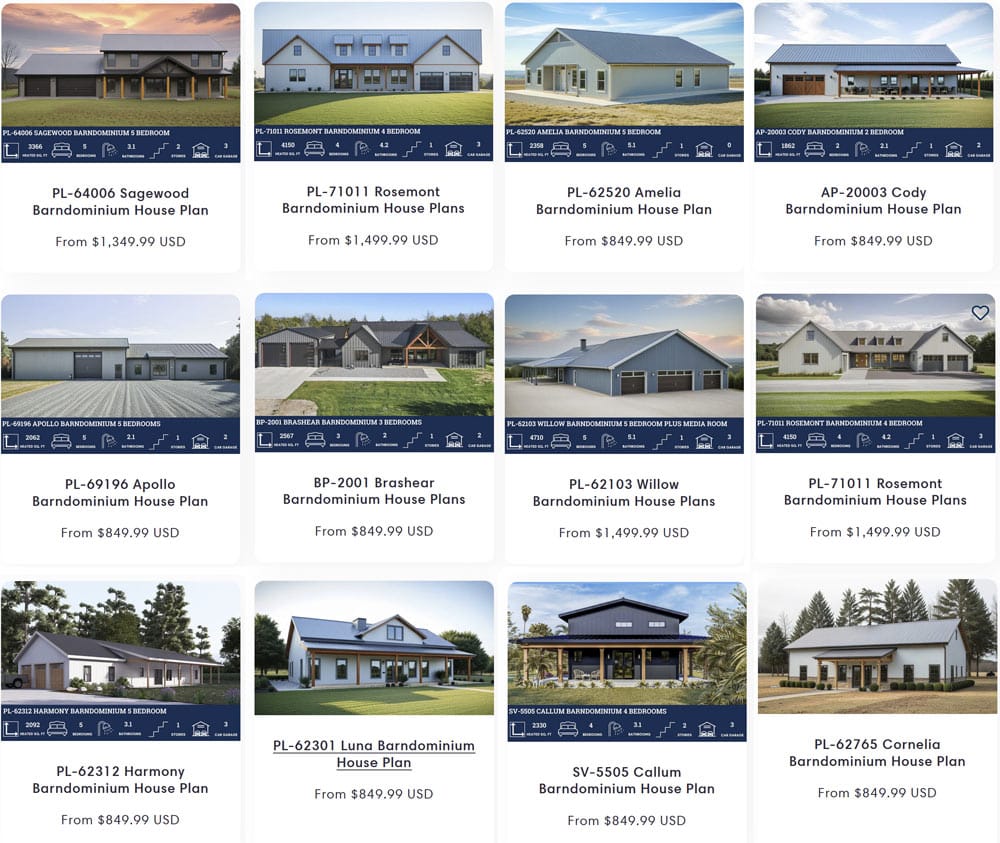
Texas Barndominium Plans Best Sellers
Expansive clay soils: Texas’s biggest hidden cost
If there’s one line item that surprises Texas barndominium builders, it’s the foundation. Large parts of the state — the Blackland Prairie running through Dallas, Waco, and Austin, and the Houston area — sit on expansive clay that swells when wet and shrinks when dry. That movement will crack a poorly designed slab.
Building on expansive clay means an engineered foundation — typically a post-tensioned slab or a pier-and-beam system designed for your soil — not a generic slab. Get a geotechnical soils test on your parcel before you finalize a foundation design or budget. It’s a modest cost that prevents the single most expensive mistake in Texas barndominium construction, and it’s a big reason foundation costs vary so much across the state.
Property taxes and the “ag exemption”
Texas has no state income tax, but it has high property taxes — which makes agricultural valuation genuinely valuable, and widely misunderstood.
The Texas “ag exemption” is really a 1-d-1 open-space agricultural valuation — a property-tax valuation based on the land’s agricultural productivity rather than market value. It is not a building exemption and has nothing to do with whether you need a permit. Two things matter when you build a home on ag land:
- The homesite is carved out. The portion around your house (often about an acre) typically loses ag valuation and is taxed at market value, while the rest of the tract can keep its ag valuation if genuine agricultural use continues.
- Rollback taxes on the converted portion. Taking land out of ag use triggers a rollback — recapture of the tax savings for the past 3 years (reduced from 5 by House Bill 3833, effective September 1, 2021), plus 7% interest. The rollback applies to the converted portion, not the whole tract if the remainder stays in ag use.
Plan the homesite deliberately, keep the balance of the land in bona fide ag use if you want to preserve the valuation, and talk to your county appraisal district before you build.
Septic and wells
This is the requirement that applies even in the most permit-free county. On-site sewage facilities (OSSF) in Texas are regulated under TCEQ Chapter 285 and administered by local authorized agents (usually the county or a river authority). You need an OSSF permit and a site/soil evaluation before installing a septic system — and since so much of rural Texas has no municipal sewer, this is nearly universal for barndominium builds.
Practical points: the system is sized to the home, a soil and site evaluation determines the system type your land can support (conventional vs. an engineered aerobic system, which costs more), and setbacks from wells and property lines apply. Get the soil evaluation before you close on land — a parcel that needs an expensive aerobic system changes your budget. If you’re on a well rather than rural water, budget for drilling and factor in depth, which varies widely across Texas.
Texas barndominium FAQ
Do you need a permit to build a barndominium in Texas?
In most unincorporated (rural) counties, no building permit is required — Texas has no statewide residential code and county authority is limited. But you’ll still need a septic (OSSF) permit, an electrical inspection, and a floodplain permit if applicable, and cities/ETJs do require full permits. Always confirm with your specific county.
Can I build a barndominium anywhere in Texas?
Almost — but private deed restrictions and HOA covenants are the real limiter. Many subdivisions and ranch tracts prohibit metal homes or set minimum sizes. Read the recorded deed restrictions before you buy.
How much does a barndominium cost in Texas?
A shell/kit runs about $20–$50 per sq ft; an owner-directed finished build $80–$120; and a full builder-managed turnkey roughly $140–$150 (about $280,000–$300,000 for 2,000 sq ft). Foundation work on expansive clay is a key cost driver. See our cost guide.
What about the coast — do I need windstorm certification?
Yes, in the 14 first-tier coastal counties (plus part of Harris east of Highway 146). New construction needs TDI windstorm certification (a WPI-8 engineering submission) to qualify for TWIA windstorm insurance. Inland Texas has no such requirement.
Will building a home cost me my ag exemption?
The homesite portion (often ~1 acre) loses its 1-d-1 ag valuation and is taxed at market value, and converting that portion triggers rollback taxes — now 3 years plus 7% interest. The rest of the tract can keep ag valuation if genuine agricultural use continues.
Do I really need a soils test?
On Texas’s expansive clay, yes — a geotechnical test is a small cost that lets your engineer design a foundation that won’t crack. It’s the most cost-effective insurance in a Texas barndominium build.
Who Are The Best Barndominium Builders In Texas?
We do not publish a ranked list, and in Texas that matters more than elsewhere: with no state licensing board, there is no credential separating a builder with twenty completed barndominiums from someone who started last month. The filter that works is completed work you can go and stand in, a structural engineer’s sealed drawing, licensed electrical, plumbing and HVAC subcontractors verified through TDLR and TSBPE, and insurance certificates sent by the agent rather than the builder.
Ready to start your Texas build?
Start with a floor plan — browse designs by size or bedroom count, any of which can be engineered for your Texas soil and wind. Browse barndominium floor plans →
Work out your budget — see the full cost guide →
Compare your options — a stock plan, a prefab SIP shell, or a steel kit. Get started →
Whichever route you take in Texas: read the deed restrictions before you buy, confirm your county’s permit rules, get a geotech soils test, arrange your OSSF/septic evaluation early, and — on the coast — plan for windstorm certification.
This page is for general informational purposes and isn’t a substitute for confirming requirements directly with your county building/development office, your county appraisal district, a licensed Texas engineer or contractor, an insurance agent, or a mortgage professional. Rules, wind maps, and local ordinances change — verify current requirements for your specific parcel before you build.
If you would like to add your business to our state guides or run a feature profile on our site please contact us below. Please send your featured build images, project details and company history to us.
If you would like to add your business to our state guides or run a feature profile on our site, contact us below. Please send your featured build images, project details and company history to us.
This page is for general informational purposes and isn't a substitute for confirming requirements directly with your county's building and zoning office, a licensed state contractor, or a mortgage professional.
We Offer 3 Paths To Get Started
Choose Your Floor plan
Choose from over 1,200 ready-to-build stock plans, available for instant download. Most stock plans can be modified to fit your specific lot starting at $400.
Best for: Residential Homes – Ready To Build
CREATE Your CUSTOM DESIGN
Have your plan drawn to fit your lot and your exact layout — no compromises. $2 per square foot for heated/living areas and $0.50 for unheated spaces.
Best for: Residential Homes – Complete Design Control
Start With A Kit
Steel kits are best for DIY customers, commercial buildings, workshops, or those looking for max savings. They are delivered to you, and you or your contractors erect the kit.
Best for: DIY Customers, Shop Houses & Garages